

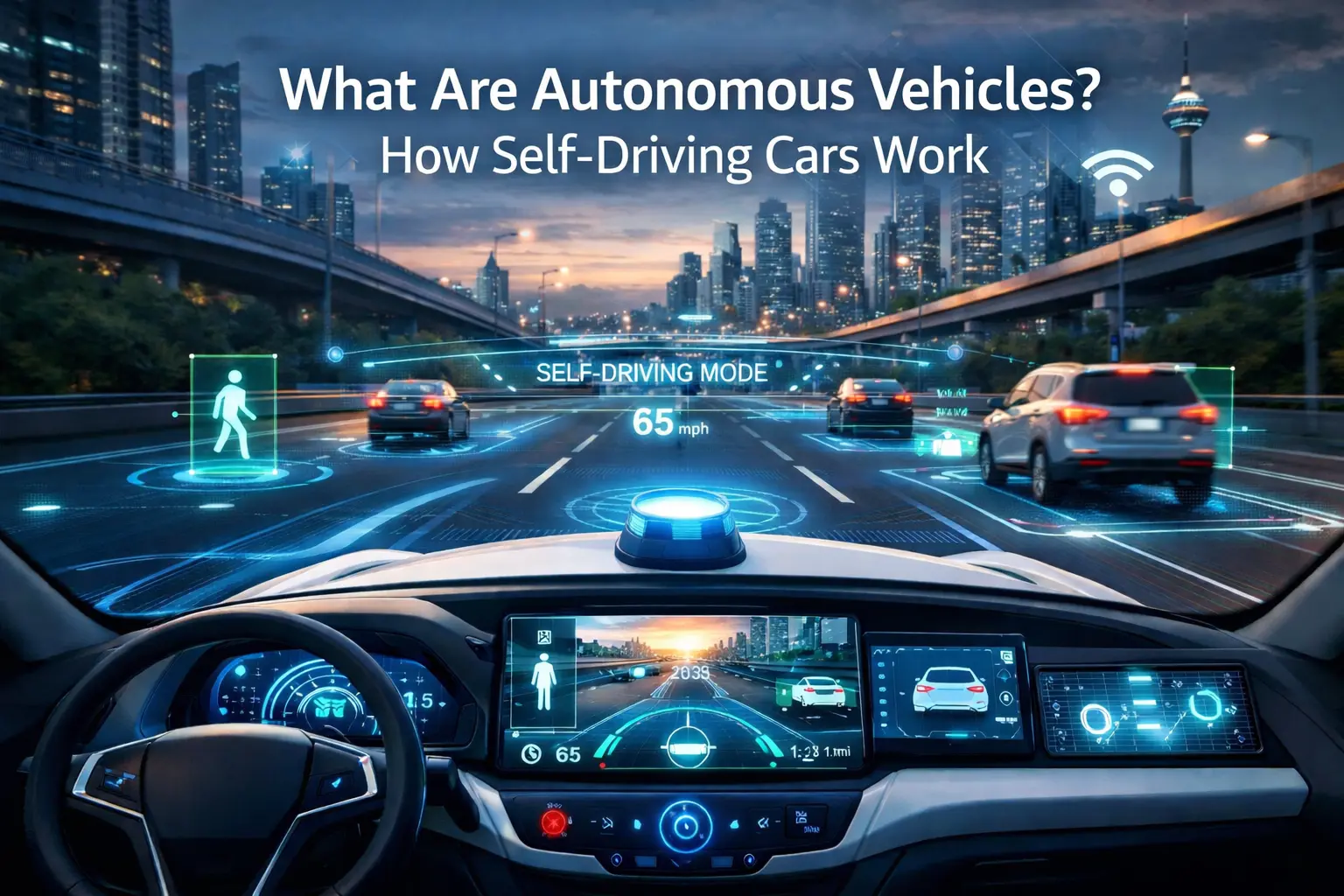
Autonomous vehicles are no longer just a futuristic idea from science fiction films. They are now one of the most important innovations in modern transportation, blending artificial intelligence, advanced sensors, real-time computing, and connected digital infrastructure into vehicles that can sense, decide, and act with limited or no human input.
As the automotive industry evolves, self-driving technology is becoming a central topic for students, tech enthusiasts, researchers, and everyday drivers. From robotaxis and smart mobility systems to advanced driver-assistance features already available in modern cars, autonomous vehicles are changing how people think about travel, safety, and the future of transportation.
To understand self-driving cars properly, it also helps to understand the wider technologies powering them, including artificial intelligence, machine learning, and modern connectivity such as 5G technology. These technologies work together to make autonomous mobility possible.
In this complete guide, we will explain what autonomous vehicles are, how self-driving cars work, the different levels of automation, their advantages and risks, and what the future may look like as this technology becomes more advanced.
Table of Contents
What Are Autonomous Vehicles?
Autonomous vehicles, also called self-driving cars or driverless cars, are vehicles designed to operate with little or no human intervention. Instead of relying entirely on a human driver to steer, brake, accelerate, observe the road, and respond to hazards, these vehicles use intelligent systems that perform many of those tasks automatically.
In simple terms, an autonomous vehicle is a car that can understand its surroundings and make driving decisions on its own. Depending on the system and the level of automation, the vehicle may only assist the driver or may be able to handle nearly the entire driving task under specific conditions.
These vehicles typically combine:
- Sensors to observe the environment
- Software to interpret road conditions
- Artificial intelligence to make decisions
- Control systems to execute steering, braking, and acceleration
- High-definition mapping and positioning for navigation
The concept is simple, but the technology behind it is highly sophisticated. Autonomous vehicles do not “see” the world the way humans do. Instead, they build a digital model of the environment using data collected from multiple systems at the same time.
Why Autonomous Vehicles Matter
Autonomous driving matters because transportation is one of the most important parts of modern life. People depend on vehicles every day for work, education, healthcare, business, and personal mobility. However, traditional driving has always carried risks, including distraction, fatigue, poor judgment, and human error.
Self-driving technology aims to reduce those weaknesses by shifting some or all of the driving responsibility from humans to intelligent systems. This has the potential to improve road safety, make transport more efficient, and create new mobility options for people who cannot drive themselves.
Autonomous vehicles also connect to a much larger digital future. In the same way that immersive systems are reshaping the future of the internet and next-generation connectivity is changing network performance, mobility is becoming smarter, more connected, and increasingly data-driven.
Levels of Autonomous Driving
Not every vehicle marketed with smart driving features is truly self-driving. This is where automation levels become important. The industry commonly refers to six levels of automation, from Level 0 to Level 5.
Level 0: No Automation
At Level 0, the human driver performs all driving tasks. The vehicle may provide warnings, such as collision alerts or lane departure alerts, but it does not actively control steering or speed.
Level 1: Driver Assistance
At Level 1, the vehicle can assist with one driving function. For example, it may control steering or maintain speed through adaptive cruise control, but not both at the same time in a sustained way.
Level 2: Partial Automation
At Level 2, the vehicle can control both steering and speed under certain conditions. However, the human driver must remain fully engaged and ready to take over immediately. Many modern “hands-on” or “hands-free assist” systems fit into this category, but they are not fully autonomous.
Level 3: Conditional Automation
At Level 3, the vehicle can handle most aspects of driving in specific environments or scenarios. The human must still be available to intervene when requested, but the system is capable of managing the driving task for periods of time.
Level 4: High Automation
At Level 4, the vehicle can perform all major driving functions within a defined operational area or under certain conditions. In those approved conditions, the system does not require human intervention.
Level 5: Full Automation
At Level 5, the vehicle is fully autonomous in all driving environments and conditions that a human driver could handle. No steering wheel or pedals would technically be necessary because the system would perform the entire driving task independently.
For the official industry framework on these levels, readers can review the SAE Levels of Driving Automation.
How Self-Driving Cars Work
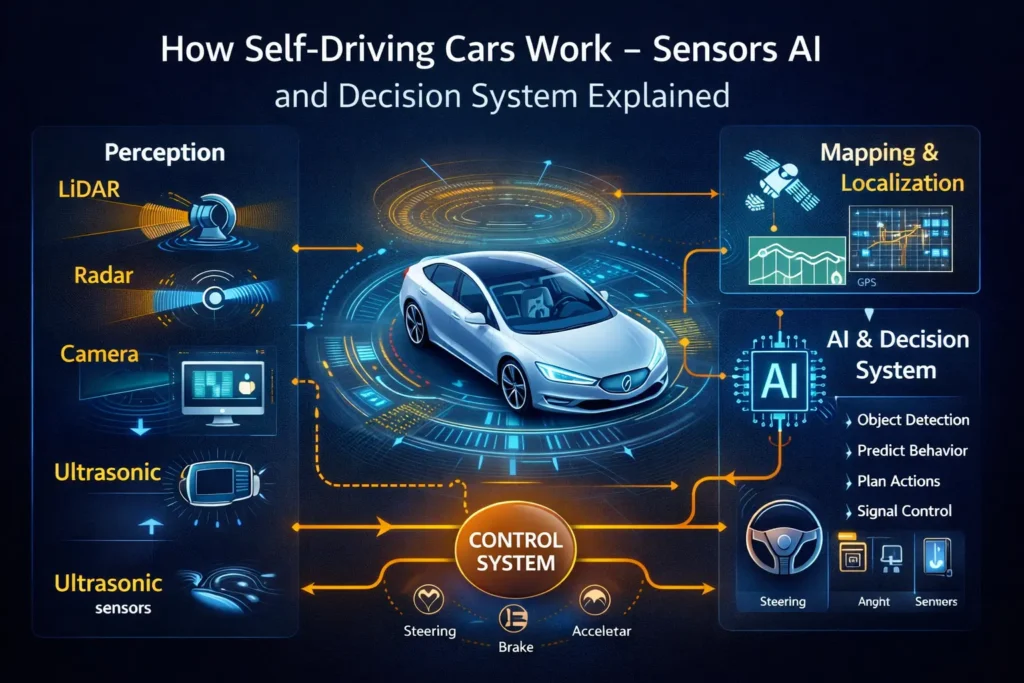
Self-driving cars operate through a coordinated system of perception, interpretation, planning, and action. Although the details can vary by manufacturer and platform, the general process follows a logical sequence.
- The vehicle senses the environment.
- It identifies and classifies objects and road features.
- It determines its exact position.
- It predicts what nearby objects may do next.
- It chooses the safest driving response.
- It controls the car’s movement in real time.
This process happens continuously, many times per second.
Sensors: How the Vehicle Sees the World
The first step in autonomous driving is perception. A self-driving vehicle must constantly monitor its surroundings to understand what is around it, what is moving, what is stationary, and what may become dangerous.
Cameras
Cameras provide visual information similar to human eyesight. They help the system recognize lane markings, traffic lights, road signs, vehicles, pedestrians, cyclists, and road edges. Cameras are particularly important for reading visual cues that are common in normal driving.
Radar
Radar uses radio waves to detect the speed, distance, and direction of objects. It performs well in poor weather and can detect vehicles or obstacles even when visibility is reduced.
LiDAR
LiDAR uses laser pulses to measure distances and build a three-dimensional map of the environment. It is highly valuable for precise spatial awareness and object detection.
Ultrasonic Sensors
Ultrasonic sensors are often used for short-range awareness, especially in parking, low-speed maneuvering, and close obstacle detection.
Each sensor has strengths and weaknesses. Cameras are rich in visual detail but can be affected by lighting. Radar works well in poor weather but may provide less detailed object shapes. LiDAR offers very precise mapping but can be expensive. By combining multiple sensor types, autonomous vehicles improve reliability and reduce blind spots.
Sensor Fusion: Combining Data for Better Decisions
A single sensor cannot provide a complete understanding of the driving environment. That is why autonomous vehicles use sensor fusion. Sensor fusion combines information from cameras, radar, LiDAR, GPS, and onboard measurement systems into one consistent model of the world.
This fused model helps the system answer key questions:
- Where exactly is the vehicle?
- What objects are nearby?
- Which objects are moving?
- How fast are they moving?
- Is the path ahead safe?
Without sensor fusion, the system would struggle to make reliable driving decisions. With it, the car can build a far more accurate representation of road conditions.
Artificial Intelligence in Self-Driving Cars
Autonomous vehicles rely heavily on AI to interpret data and make decisions. This is one of the clearest real-world applications of artificial intelligence and machine learning.
AI in self-driving systems is responsible for tasks such as:
- Object recognition
- Lane detection
- Traffic sign interpretation
- Pedestrian and cyclist detection
- Behavior prediction
- Decision-making and path planning
Machine learning models are trained on large volumes of driving data. These datasets include different road layouts, lighting conditions, weather conditions, traffic patterns, and hazard scenarios. Over time, the system learns to recognize patterns and improve its responses.
This is why machine learning is so important in modern autonomous systems. Instead of relying only on rigid programmed rules, the vehicle can adapt its behavior based on learned patterns and statistical models.
Localization and Mapping
Knowing what is around the car is only part of the challenge. The vehicle must also know exactly where it is.
Localization is the process of determining the vehicle’s precise position on the road. This is more advanced than ordinary navigation in consumer smartphones. Autonomous vehicles may use high-definition maps that include lane-level details, road curvature, intersections, traffic-control devices, and other structural information.
GPS helps with general positioning, but GPS alone is often not accurate enough for safe automated driving. That is why autonomous vehicles combine GPS with onboard sensors, inertial measurement systems, and mapping data to improve positional accuracy.
These high-definition maps act like a reference framework. The car compares real-time sensor input with the map and determines its exact location, lane position, and expected road structure.
Prediction: Understanding What Others May Do
Driving is not only about reacting to what is happening now. It also requires anticipating what may happen next. A pedestrian standing near the curb may step into the road. A nearby driver may suddenly change lanes. A cyclist may move unpredictably around parked vehicles.
Autonomous systems therefore use prediction models to estimate likely movements of surrounding road users. This is one of the most difficult aspects of self-driving technology because human behavior is often uncertain.
The vehicle must constantly ask:
- Will that car slow down or turn?
- Will that pedestrian cross the road?
- Will the traffic light change soon?
- Is a vehicle in the next lane about to merge?
By predicting potential behavior, the system can plan more safely and avoid sudden, unsafe reactions.
Planning and Decision-Making
After sensing, interpreting, mapping, and predicting, the autonomous driving system must decide what to do. This stage is often called planning or decision-making.
The vehicle selects a safe driving path based on:
- Traffic rules
- Road geometry
- Speed limits
- Distance to obstacles
- Behavior of nearby vehicles
- Destination and navigation route
Examples of planning decisions include:
- Stopping at a red light
- Changing lanes to avoid a slow vehicle
- Yielding to pedestrians
- Taking a safe highway exit
- Maintaining a safe following distance
These decisions are made continuously in real time. The system must respond within fractions of a second, especially in complex traffic situations.
Vehicle Control Systems
Once the system has decided what to do, it must translate that decision into physical action. This is the role of the control system.
The control system manages:
- Steering angle
- Brake pressure
- Throttle input
- Stability adjustments
For smooth driving, control must be accurate and responsive. Sudden braking, poor lane centering, or delayed acceleration can make the ride unsafe or uncomfortable. A high-quality autonomous system therefore aims not only for safety but also for stability and passenger comfort.
The Role of Connectivity and Real-Time Data
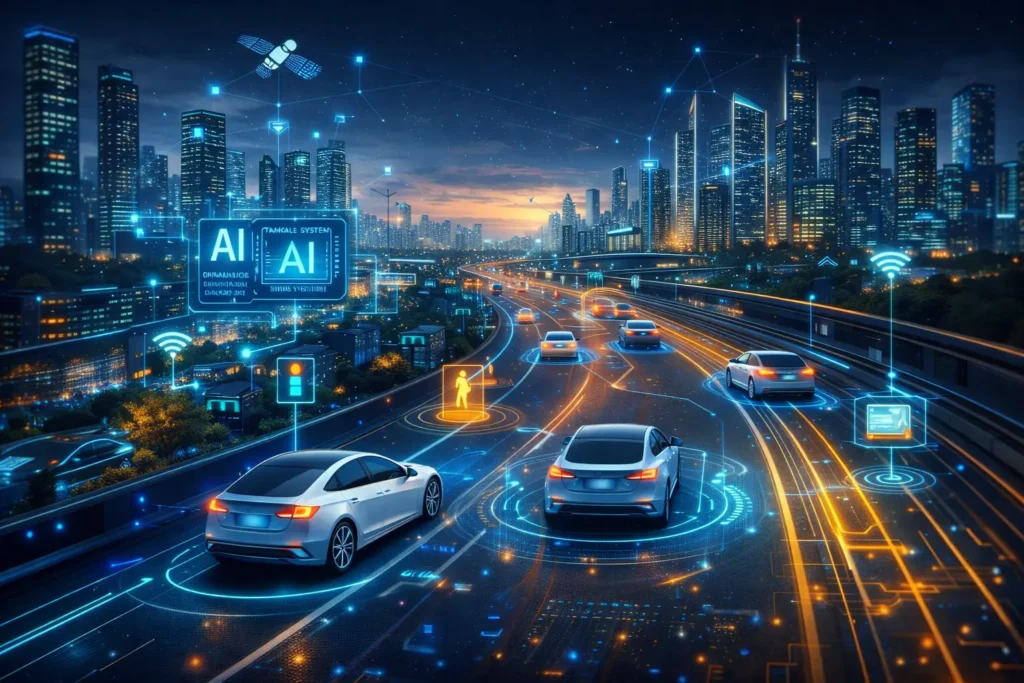
Autonomous vehicles do not exist in isolation. They increasingly depend on connected digital infrastructure. Faster, lower-latency connectivity can improve map updates, traffic awareness, software updates, and cloud-assisted intelligence. This is one reason why 5G technology is often discussed alongside autonomous mobility.
In the future, connected vehicles may exchange information with:
- Other vehicles
- Traffic lights
- Road sensors
- City traffic systems
- Cloud-based mapping platforms
This type of connected ecosystem could make transportation more efficient and responsive, especially in smart-city environments.
Real-World Examples of Autonomous Vehicle Development
Several companies are actively developing and deploying autonomous driving systems. Some focus on personal vehicles with advanced driver assistance. Others are building robotaxi fleets or commercial autonomous platforms.
One widely recognized real-world example is Waymo Driver, which presents its technology as a fully autonomous driving system for real-world mobility use cases.
Government safety agencies also track the broader category of automated vehicle systems. Readers who want a safety-focused overview can review NHTSA’s automated vehicle safety overview and the agency’s information on automated driving systems.
Benefits of Autonomous Vehicles
1. Improved Road Safety
One of the biggest promises of autonomous vehicles is safety. Human drivers can become tired, distracted, angry, careless, or impaired. Autonomous systems do not get sleepy or text while driving. In theory, this could reduce many crash risks associated with human behavior.
2. Better Accessibility
Autonomous mobility could help elderly people, people with disabilities, and individuals who are unable to drive independently. This could improve freedom, access to services, and quality of life.
3. Traffic Efficiency
Smart autonomous systems may eventually optimize speed, spacing, lane usage, and route planning more effectively than human drivers, reducing congestion and improving overall traffic flow.
4. More Productive Travel Time
If the vehicle handles driving, passengers can potentially use travel time for work, learning, rest, or communication.
5. Integration with Future Smart Systems
Autonomous vehicles fit naturally into a broader technology ecosystem that includes smart cities, connected infrastructure, AI systems, and even immersive digital environments discussed in topics like virtual reality and augmented reality.
Challenges and Risks of Self-Driving Cars
1. Safety in Edge Cases
While autonomous vehicles can perform well in many conditions, unusual situations remain difficult. Construction zones, unusual road markings, emergency responders, unexpected pedestrian behavior, or extreme weather can challenge even advanced systems.
2. Driver Overtrust
One major risk is when users assume a partially automated vehicle is fully self-driving. This misunderstanding can reduce attention and create dangerous situations. For background on safety issues related to automation and crash-avoidance systems, readers can review IIHS automation and advanced driver-assistance research.
3. Legal and Regulatory Complexity
Laws, liability, insurance frameworks, testing standards, and roadway regulations all become more complex when a machine is responsible for driving decisions.
4. Cybersecurity
Connected vehicles may also become cyber targets. Any system that relies on software, wireless communication, and remote updates must be designed with strong security protections.
5. Cost and Infrastructure
Advanced sensor systems, computing platforms, mapping systems, and supporting infrastructure can make autonomous vehicle development expensive. Large-scale deployment may take years.
Autonomous Vehicles and the Future of Transportation
The future of autonomous vehicles will not be shaped by cars alone. It will also depend on software engineering, cloud systems, network performance, regulation, and digital ecosystems. Even fields such as software and systems development remain relevant because autonomous mobility depends on reliable interfaces, backend services, real-time data systems, and secure platforms.
Over time, autonomous systems may expand into:
- Robotaxi services
- Autonomous logistics and delivery
- Smart public transport systems
- Connected highway networks
- Integrated urban mobility platforms
The long-term vision is not just a car that drives itself. It is a fully connected mobility ecosystem where vehicles, infrastructure, software, and communications systems work together to move people and goods more safely and efficiently.
Are We Already at Full Self-Driving?
Not yet in the broad everyday sense. Although many modern vehicles include impressive automation features, truly universal Level 5 autonomy across all roads and conditions is still not a mainstream reality. Most consumer systems today remain in Level 1 or Level 2 categories, while more advanced systems operate in limited geofenced or specialized environments.
This distinction is important because marketing language can sometimes create unrealistic expectations. A vehicle with advanced assistance features is not necessarily a fully autonomous vehicle.
Frequently Asked Questions
What is an autonomous vehicle?
An autonomous vehicle is a vehicle that uses sensors, software, and intelligent control systems to perform driving tasks with limited or no human intervention.
How do self-driving cars work?
Self-driving cars work by combining sensors, AI, maps, localization, prediction systems, and control mechanisms to observe the environment, make decisions, and operate the vehicle in real time.
Are self-driving cars the same as driver-assistance cars?
No. Driver-assistance systems support the human driver, while autonomous systems aim to take over more of the driving task. The difference depends on the vehicle’s automation level.
What technologies are most important in autonomous vehicles?
The most important technologies include artificial intelligence, machine learning, cameras, radar, LiDAR, high-definition mapping, real-time computing, and connected network systems.
Why is 5G discussed with autonomous vehicles?
Because lower-latency and higher-speed connectivity can support data sharing, map updates, cloud services, and future connected-vehicle infrastructure.
Conclusion
Autonomous vehicles represent one of the most important transformations in the history of transportation. They combine AI, machine learning, sensors, mapping, prediction, and real-time control into systems capable of assisting or, in some cases, taking over the driving task.
Although fully autonomous mobility is still developing, the direction is clear. Vehicles are becoming smarter, more connected, and increasingly capable of understanding the world around them. As the technology matures, autonomous vehicles may improve road safety, expand accessibility, and redefine how people move through modern cities and digital societies.
For students, technology readers, and anyone interested in the future of mobility, understanding autonomous vehicles is no longer optional. It is becoming an essential part of understanding the next era of transportation itself.