

Robotics & Automation Future Careers are becoming one of the most important topics for students, professionals, and technology-driven industries. The global workforce is changing faster than at any other time in recent history, and robotics and automation are now leading that transformation. Industries that once depended almost entirely on human labor are being reshaped by intelligent machines, connected systems, and advanced software.
Robotics & Automation Future Careers are no longer limited to engineers in advanced laboratories or technicians in industrial plants. They now include software developers, AI specialists, system designers, maintenance experts, data analysts, human-machine interaction professionals, and many other roles that did not exist at the same scale just a decade ago. For students, young professionals, and anyone planning a future-ready career, Robotics & Automation Future Careers offer one of the most promising paths in the modern economy.
What makes this field especially important is that it sits at the intersection of several high-growth technologies. Artificial intelligence, machine learning, embedded systems, computer vision, industrial internet of things, cloud platforms, and smart analytics are all feeding into the expansion of automation. This means the field is not only growing, but also evolving continuously. Those who enter it today are positioning themselves at the front of a long-term global shift.
In this comprehensive guide, we will explore what robotics and automation really mean, why these technologies are becoming critical to modern economies, which roles are expected to shape the future, what skills employers value most, how students can prepare themselves, and why Robotics & Automation Future Careers are increasingly seen as one of the smartest professional choices of the coming decade.
Table of Contents
Why Robotics & Automation Future Careers Matter in 2026
Robotics & Automation Future Careers matter in 2026 because global industries are investing heavily in smart factories, AI-driven systems, autonomous machines, intelligent infrastructure, and advanced industrial control platforms. Employers are not only looking for people who can build these systems, but also for professionals who can manage, improve, troubleshoot, and scale them. This is why Robotics & Automation Future Careers are now considered future-proof, high-value, and globally relevant.
Another reason these careers matter is that they are connected to real economic demand rather than short-term hype. Organizations want efficiency, accuracy, safety, scalability, and better decision-making. Robotics and automation help deliver all of these. As a result, future careers in robotics and automation are becoming more central to manufacturing, healthcare, agriculture, transportation, logistics, energy, and smart city development.
What Is Robotics?
Robotics is a multidisciplinary field focused on the design, construction, programming, and operation of machines that can perform tasks with varying levels of autonomy. A robot may be a physical machine working in a factory, a surgical system assisting doctors in an operating room, a warehouse picker moving goods, a drone flying over farmland, or a humanoid system designed to interact with people.
Modern robotics combines several areas of expertise. Mechanical engineering gives robots their physical structure and movement. Electrical and electronics engineering powers their circuits, motors, and sensors. Computer science provides programming logic, control systems, and decision-making capabilities. Artificial intelligence allows many modern robots to recognize patterns, respond to changing environments, and improve performance over time.
Robots are especially valuable in environments where tasks are dangerous, repetitive, extremely precise, or physically demanding. In manufacturing, robotic arms assemble components with consistency and speed. In healthcare, robotic systems assist with delicate surgical procedures. In space exploration, robots travel into conditions too hostile for humans. In agriculture, automated machines can monitor crops, spray fields, and harvest produce with growing efficiency.
The significance of robotics is no longer limited to replacing repetitive physical effort. Increasingly, robots are becoming tools for accuracy, safety, productivity, and decision support. As their capabilities expand, so do the professional opportunities around them, especially in the broader landscape of Robotics & Automation Future Careers.
What Is Automation?
Automation refers to the use of technology, systems, and software to perform tasks with reduced human intervention. While robotics often involves physical machines, automation is broader. It includes both physical and digital systems designed to make operations faster, more accurate, and more efficient.
In industrial settings, automation may include conveyor systems, robotic arms, programmable logic controllers, sensors, and supervisory control systems. In offices, automation may involve software bots, workflow systems, data processing platforms, and decision-support tools. In homes, it may appear as smart lighting, connected appliances, security systems, or voice-controlled environments.
Automation can be divided into several categories. Fixed automation is used for highly repetitive production processes where speed and volume are priorities. Programmable automation is more flexible and can be adjusted for different tasks. Intelligent automation adds artificial intelligence, machine learning, and analytics so that systems can adapt, predict problems, and optimize performance.
The real power of automation lies in scale. A well-designed automated system can reduce human error, improve product quality, lower costs, increase safety, and allow organizations to respond more quickly to changing market needs. This is why automation is becoming essential across nearly every major sector of the economy and why careers in robotics and automation continue to expand.
Why Robotics and Automation Matter More Than Ever
There are several reasons why robotics and automation are receiving so much global attention. First, businesses everywhere are under pressure to increase productivity while managing costs. Automation helps organizations achieve more output with greater consistency. Second, many sectors face labor shortages, especially in roles that involve repetitive, difficult, or technically demanding work. Robotics can help fill these gaps while allowing human workers to move into more strategic positions.
Third, technological progress has made robotics and automation more practical and affordable than in the past. Sensors are better, processors are faster, software is more capable, cloud infrastructure is stronger, and AI tools are far more accessible. Fourth, global competition is forcing industries to modernize quickly. Companies that fail to adopt automation risk falling behind in efficiency, quality, and responsiveness.
For workers and students, this does not mean that machines will simply eliminate opportunities. In reality, many jobs will change, and many new roles will emerge. The strongest opportunities will go to people who understand how to design, manage, improve, repair, and work alongside automated systems. That is exactly why Robotics & Automation Future Careers are becoming so important.
How Robotics and Automation Are Changing Careers
One of the biggest misconceptions about automation is that it only destroys jobs. The truth is more complex. Automation does remove certain repetitive tasks, but it also creates demand for new expertise. When factories become smarter, they need automation engineers, control specialists, and robotics technicians. When hospitals adopt advanced robotics, they need trained operators, maintenance teams, and system integrators. When logistics networks become automated, they require warehouse systems analysts, robotics programmers, and performance optimization experts.
Another important shift is that many roles are becoming hybrid. A modern automation engineer may need to understand software as well as hardware. A robotics specialist may need knowledge of AI, machine vision, and cloud-based monitoring. A technician may need to troubleshoot mechanical, electrical, and software issues together. This blending of disciplines means that the field rewards continuous learning and versatility.
For students, that is actually good news. It means there is no single narrow entry path. People can enter from computer science, electrical engineering, mechanical engineering, mechatronics, industrial technology, data science, and even operations backgrounds. What matters most is the ability to build practical skills and adapt to evolving technologies in Robotics & Automation Future Careers.
Top Robotics & Automation Future Careers for Students and Professionals
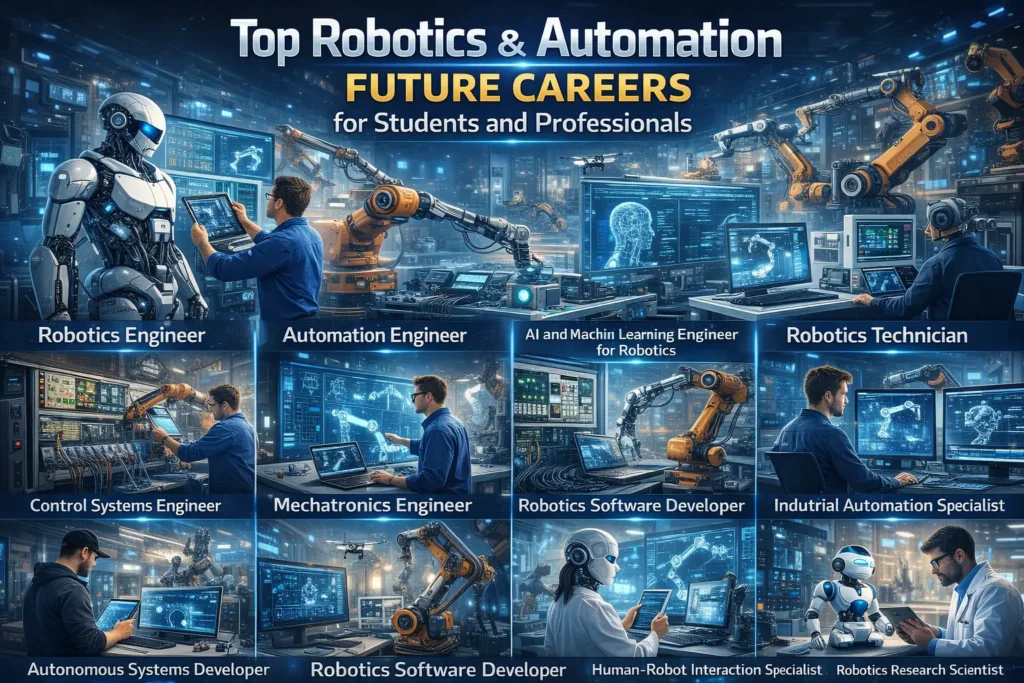
The best Robotics & Automation Future Careers combine technical skill, innovation, and long-term industry demand. Whether you want to work in manufacturing, healthcare, logistics, agriculture, energy, or AI development, Robotics & Automation Future Careers now offer a wide range of high-growth opportunities across local and global markets.
1. Robotics Engineer
A robotics engineer designs, develops, tests, and improves robotic systems. This role is often considered one of the core careers in the field because it blends hardware and software into practical, working machines. Robotics engineers may work on industrial robots, medical systems, service robots, autonomous machines, or research prototypes.
The role typically requires knowledge of programming, kinematics, control systems, electronics, embedded systems, sensors, and mechanical design. In many companies, robotics engineers also collaborate with software teams, manufacturing teams, and data specialists to ensure systems work reliably in real environments.
This is a strong career path for people who enjoy solving complex technical problems and creating systems that directly interact with the physical world.
2. Automation Engineer
An automation engineer focuses on designing systems that reduce manual intervention in industrial or business processes. These professionals work with control systems, PLCs, SCADA platforms, industrial communication networks, sensors, and process optimization tools.
Automation engineers are essential in manufacturing plants, energy facilities, food processing units, pharmaceutical production, utilities, and smart infrastructure projects. Their work often involves improving system efficiency, troubleshooting production issues, ensuring safety, and integrating new technologies into existing operations.
Because industries worldwide are upgrading their facilities, this role continues to offer strong long-term demand.
3. AI and Machine Learning Engineer for Robotics
As robots become smarter, AI and machine learning engineers are becoming increasingly important. These professionals develop algorithms that allow machines to recognize objects, interpret environments, make predictions, and improve performance through data.
In robotics, AI is used for navigation, computer vision, predictive maintenance, human-machine interaction, speech recognition, anomaly detection, and decision-making. Professionals in this role usually need strong backgrounds in mathematics, programming, data handling, and machine learning frameworks.
This is one of the most advanced and potentially high-paying career paths within the broader robotics and automation landscape.
4. Robotics Technician
Robotics technicians play a practical and critical role. While engineers may design systems, technicians often install, maintain, calibrate, test, and repair them. In factories and other operational settings, technicians are essential for keeping automated systems running efficiently.
This role is especially suitable for people who prefer hands-on work rather than purely theoretical or desk-based responsibilities. Strong troubleshooting ability, knowledge of mechanical and electrical systems, and familiarity with control equipment are valuable here.
As automation expands in manufacturing and logistics, demand for skilled robotics technicians is expected to remain strong.
5. Control Systems Engineer
A control systems engineer develops the logic and architecture that allow automated systems to function smoothly and safely. These professionals design controllers, feedback loops, process regulation systems, and performance monitoring frameworks.
Control systems are used in factories, aircraft systems, power plants, transportation infrastructure, and many industrial environments. Engineers in this field often work with simulation tools, industrial software, and real-time process data. Their work helps ensure that automated systems remain stable, efficient, and precise under changing conditions.
6. Mechatronics Engineer
Mechatronics engineering sits at the heart of modern robotics and automation. It combines mechanics, electronics, software, and control systems into integrated products and machines. A mechatronics engineer may work on manufacturing equipment, smart appliances, robotic devices, medical instruments, or autonomous platforms.
This role is particularly valuable because many employers need professionals who can understand multiple layers of a system rather than just one. Students who want a broad and flexible foundation often find mechatronics to be an excellent path into future-focused industries.
7. Autonomous Systems Developer
Autonomous systems developers work on machines that operate with minimal direct human control. This includes self-driving vehicles, drones, mobile robots, smart navigation systems, and advanced monitoring platforms.
These professionals usually need expertise in perception systems, mapping, navigation, machine learning, sensor fusion, and embedded software. The field is technically demanding, but it is also one of the most exciting because it represents the leading edge of robotics innovation.
As autonomous mobility, defense technology, smart agriculture, and last-mile logistics expand, demand for this specialization is likely to grow.
8. Robotics Software Developer
Not all robotics careers involve mechanical design. Robotics software developers write the code that powers robotic behavior, coordination, communication, and intelligence. They may work on system control software, simulation tools, user interfaces, motion planning, machine vision pipelines, or cloud-connected robotics platforms.
Programming languages such as Python and C++ are especially common in this domain. Knowledge of robotics frameworks, testing environments, and operating systems can also be important. This role is ideal for software-focused professionals who want to work in the physical computing world.
9. Industrial Automation Specialist
Industrial automation specialists focus specifically on optimizing factory and production environments. They may configure control systems, improve workflow efficiency, analyze bottlenecks, monitor industrial sensors, and support plant modernization projects.
This role often overlaps with automation engineering, but it is usually more operational and implementation-focused. It is especially valuable in sectors such as automotive production, packaging, food manufacturing, chemicals, textiles, and heavy industry.
10. Human-Robot Interaction Specialist
As robots move into workplaces, hospitals, homes, and public spaces, there is growing need for specialists who understand how humans and machines can interact safely and effectively. Human-robot interaction specialists focus on usability, interface design, communication, safety behavior, and trust-building between people and automated systems.
This role may involve elements of design, psychology, AI, user experience, and system engineering. It is an emerging field, but one that is expected to become increasingly important as collaborative robots become more common.
11. Data Analyst for Automated Systems
Automation generates large volumes of data. Machines report uptime, failures, throughput, energy usage, quality trends, and performance deviations. Data analysts in this space help organizations understand that data and turn it into better operational decisions.
They may identify inefficiencies, recommend predictive maintenance strategies, improve production planning, and support quality assurance. This role is ideal for people who enjoy analytics and want to apply data skills to real-world industrial performance.
12. Robotics Research Scientist
Robotics research scientists explore new methods, systems, algorithms, and designs that can shape the future of the field. They may work at universities, R&D centers, technology firms, defense labs, healthcare innovation organizations, or advanced manufacturing institutes.
This career usually requires strong academic training and a deep interest in pushing the limits of current technology. Research scientists help create the breakthroughs that later become commercial products and real-world systems.
One major advantage of choosing Robotics & Automation Future Careers is flexibility. These roles are not tied to one country or one industry. As automation expands globally, Robotics & Automation Future Careers are becoming valuable in both developed and emerging markets.
Industries Creating the Highest Demand
The strength of Robotics & Automation Future Careers comes partly from the fact that they are not tied to only one sector. Demand is growing across many industries.
Manufacturing remains one of the largest employers in this field. Smart factories rely on automated assembly, quality control, packaging, inspection, and predictive maintenance. Healthcare is expanding through robotic surgery, rehabilitation devices, hospital logistics, and laboratory automation. Logistics and warehousing continue to adopt automated picking, sorting, routing, and inventory systems.
Agriculture is becoming more technology-driven through precision farming, automated tractors, drones, and intelligent monitoring systems. Energy and utilities use automation for grid monitoring, plant operations, and maintenance systems. Transportation is seeing growth in driver assistance, autonomous systems, and smart traffic infrastructure. Even retail, hospitality, construction, and defense are developing new automation applications that require skilled professionals.
Skills Required for Robotics and Automation Careers
To succeed in Robotics & Automation Future Careers, students and professionals need a strong blend of technical knowledge, practical problem-solving ability, and adaptability. Because robotics and automation combine software, hardware, electronics, and intelligence, employers increasingly value candidates who can work across disciplines.
On the technical side, programming is one of the most important foundations. Python and C++ are especially common. Knowledge of electronics, circuits, sensors, actuators, and microcontrollers is valuable. For automation roles, PLC programming, industrial communication systems, and SCADA platforms are often relevant. For advanced robotics, machine learning, computer vision, embedded systems, and robot operating environments can provide strong advantages.
Mathematics also matters more than many beginners expect. Algebra, geometry, calculus, statistics, and logic can all support work in control systems, AI, and modeling. Understanding data analysis is increasingly useful because automated systems generate significant operational information.
Soft skills are equally important. Problem-solving is essential because complex systems rarely behave perfectly in real environments. Communication matters because robotics and automation projects are usually team-based. Adaptability is crucial because tools and standards change over time. Attention to detail is important because small technical mistakes can cause large operational failures.
Education Pathways for Students
Students who want to build strong careers in this field should choose an education path that supports long-term growth in Robotics & Automation Future Careers. A degree in robotics engineering, mechatronics, electrical engineering, mechanical engineering, computer science, or industrial automation can all provide a strong foundation.
Practical experience is extremely important. Students should aim to build projects, join competitions, work with microcontrollers, learn basic programming, and explore automation tools wherever possible. Even small projects such as line-following robots, smart home systems, sensor-based devices, or simple PLC exercises can help build real understanding.
Certifications can also be valuable, especially in automation software, PLC systems, industrial networking, AI fundamentals, and machine learning. Online learning platforms have made it easier than ever to build practical knowledge, but structured study and hands-on application remain key to standing out.
Internships are one of the best ways to transition from theory to professional readiness. Working in a plant, lab, workshop, or automation company helps students understand how systems behave outside the classroom.
How Beginners Can Start in a Smart Way
Beginners often feel overwhelmed because robotics and automation seem broad and technically demanding. The best approach is not to try learning everything at once. Start with a clear progression.
First, build comfort with programming fundamentals. Second, learn the basics of electronics and sensors. Third, understand how simple control systems work. Fourth, create small projects that combine software and hardware. Fifth, choose an area of interest such as industrial automation, robotics software, AI for robotics, or mechatronics. This step-by-step path is far more effective than jumping directly into advanced systems without a foundation.
It is also wise to document your projects. A portfolio of practical work can be extremely useful when applying for internships, jobs, or university programs. Employers often value demonstrated skill more than generic claims of interest, especially when hiring for future careers in robotics and automation.
Salary Potential and Long-Term Value
One of the reasons these careers attract so much attention is the combination of strong demand and attractive income potential. Salaries vary by country, industry, experience, and specialization, but overall the field tends to reward technical expertise well. Roles involving AI, autonomous systems, advanced software, and specialized industrial automation can be especially valuable.
Beyond salary, there is also long-term career resilience. Because robotics and automation are tied to structural technological change, they are less likely to disappear than trend-based occupations. People who build strong foundations in this space can often move between industries as opportunities evolve. That flexibility makes these careers especially appealing in uncertain economic times.
Future Trends That Will Shape the Next Decade
Several major trends are likely to shape the next phase of robotics and automation. One is the rise of collaborative robots, often called cobots, which are designed to work safely alongside humans. Another is the increasing use of computer vision, allowing machines to interpret images and environments more intelligently.
Predictive maintenance will become more common as AI systems analyze machine data to prevent failures before they happen. Digital twins, which are virtual models of physical systems, will improve testing, monitoring, and optimization. Autonomous mobile systems will expand in warehouses, agriculture, transportation, and public services. Healthcare robotics will continue to advance through surgical precision, rehabilitation support, and patient-assistance technologies.
These developments suggest that Robotics & Automation Future Careers will become even broader and more specialized over time. People entering the field now may find themselves working in roles that are still emerging.
Challenges in the Field
No serious career discussion is complete without acknowledging the challenges. Robotics and automation require continuous learning. Tools, standards, and technologies evolve quickly. Some roles demand significant technical depth, especially in AI, control systems, or embedded programming. Beginners may need patience before they feel confident.
There are also ethical and social discussions around automation, including job displacement, workforce retraining, safety, and responsibility in autonomous decision-making. Professionals in this field need not only technical ability but also awareness of how technology affects people and institutions.
Still, these challenges do not weaken the value of the field. In many ways, they strengthen it. They show that robotics and automation are not temporary trends but serious, high-impact disciplines that require thoughtful, skilled professionals.
Why This Is a Strong Career Choice for the Future
Students and professionals today are often told to prepare for uncertainty. In that context, robotics and automation offer a compelling answer. They are driven by real industrial demand, powered by long-term technological investment, and relevant across multiple sectors. They combine hardware, software, intelligence, and operations in ways that make them deeply valuable to modern economies.
Perhaps most importantly, these careers allow people to work on meaningful problems. Whether improving safety in factories, increasing precision in healthcare, optimizing food production, modernizing logistics, or supporting infrastructure, professionals in this field contribute directly to systems that shape everyday life.
For those willing to develop strong fundamentals, stay curious, and keep building their skills, the opportunities are substantial. The future will not be built by machines alone. It will be built by people who know how to design, manage, improve, and work with intelligent systems at the core of Robotics & Automation Future Careers.
Conclusion
Robotics & Automation Future Careers represent one of the most important professional frontiers of the modern age. As industries become smarter, more connected, and more data-driven, demand for skilled talent in robotics and automation will continue to rise. The field offers technical challenge, global relevance, strong earning potential, and long-term growth.
For students, this is an ideal time to begin. For professionals considering a shift, it is a strong direction to explore. For educators and organizations, it is a field that deserves serious attention and investment. The future of work is not a distant idea. It is already unfolding, and Robotics & Automation Future Careers are at its center.
Those who prepare now will not simply adapt to the future. They will help create it through the expanding world of Robotics & Automation Future Careers.
Frequently Asked Questions
Are Robotics & Automation Future Careers a good choice in 2026?
Yes. Robotics & Automation Future Careers are among the strongest career options in 2026 because they combine engineering, software, AI, and practical problem-solving across multiple high-growth industries.
Do automation careers require coding?
Many automation careers do require at least some programming knowledge. The level depends on the role, but coding is increasingly valuable in both industrial and intelligent automation environments.
Which degree is best for robotics and automation?
Relevant degrees include robotics engineering, mechatronics, electrical engineering, mechanical engineering, computer science, and industrial automation. Practical skills and projects are also very important.
Can beginners start learning robotics and automation?
Yes. Beginners can start with programming, electronics basics, sensors, microcontrollers, and small practical projects before moving into advanced systems.
What industries offer jobs in robotics and automation?
Major industries include manufacturing, healthcare, agriculture, logistics, transportation, energy, defense, retail, and smart infrastructure.
Are robotics and automation careers high paying?
In many markets, yes. Salaries vary by specialization and experience, but the field generally offers strong earning potential, especially in advanced technical roles.
Explore More
- What Are Autonomous Vehicles? How Self-Driving Cars Work
- What Is SEO? How It Works and How to Learn It