

Ethical hacking is one of the most in-demand cybersecurity skills in the digital world. If you want to understand what ethical hacking is, how it works, and how to learn ethical hacking step by step, this beginner-friendly guide will help you start the right way. From networking and Linux to penetration testing tools and professional certifications, ethical hacking opens the door to a fast-growing and highly respected technology career.
As businesses, banks, schools, hospitals, and even governments rely more heavily on digital systems, cyber threats continue to grow. Attackers look for weaknesses in websites, servers, applications, networks, and user behavior. Ethical hackers help stop those threats before real damage happens. Instead of breaking systems for crime or profit, they test systems legally to find vulnerabilities and help organizations fix them.
For students, beginners, freelancers, and professionals who want to build a future-proof career, ethical hacking can be an exciting path. It combines technical knowledge, curiosity, problem-solving, and responsibility. In this complete guide, you will learn what ethical hacking means, why it matters, what skills you need, which tools are commonly used, how long it takes to learn, and how to start from zero in a practical and legal way.
Table of Contents
What Is Ethical Hacking?
Ethical hacking is the legal and authorized process of testing computers, networks, servers, websites, applications, or digital systems to identify security weaknesses before cybercriminals can exploit them. The person performing this work is called an ethical hacker, sometimes also known as a white-hat hacker.
An ethical hacker uses many of the same techniques, methods, and tools that malicious hackers use. The difference is not the technology alone. The real difference is permission, purpose, and legality. A criminal hacker attacks systems without authorization to steal data, damage systems, demand ransom, or misuse access. An ethical hacker works with permission, follows defined rules, documents findings, and helps improve security.
In simple words, ethical hacking means “hacking for protection.” It is a controlled security test that helps organizations answer important questions such as:
- Can an attacker break into our systems?
- Which vulnerabilities are most dangerous?
- How much damage could happen if a weakness is exploited?
- How can we fix the issue before a real attacker finds it?
Ethical hacking is closely related to areas like cybersecurity, penetration testing, vulnerability assessment, red teaming, web application security, network security, and security auditing. In many organizations, ethical hackers work alongside security analysts, system administrators, developers, compliance teams, and incident response experts.
Why Ethical Hacking Is Important
Every connected system can become a target. Websites may suffer from injection attacks, phishing campaigns may steal passwords, misconfigured servers may expose private data, and insecure applications may allow unauthorized access. Even small businesses are targeted because attackers often use automated tools to scan the internet for easy weaknesses.
This is why ethical hacking is important. It helps organizations discover security flaws early and fix them before attackers can use them. Instead of waiting for a data breach, a company can test its own defenses in advance.
Ethical hacking supports security in many ways:
- Prevents financial loss: Data breaches, downtime, recovery costs, and fines can be extremely expensive.
- Protects sensitive data: Customer records, passwords, payment details, and business documents need strong protection.
- Builds trust: Customers are more likely to trust businesses that take security seriously.
- Improves compliance: Many industries must meet security standards and regulatory requirements.
- Strengthens security teams: Ethical hacking reveals real weaknesses, not just theoretical risks.
As the digital economy grows, ethical hacking is no longer optional for serious organizations. It has become a core part of modern security strategy.
Types of Hackers
To understand ethical hacking clearly, it helps to know the common categories of hackers.
1. White Hat Hackers
White-hat hackers are ethical hackers. They work legally, with permission, and their purpose is to improve security. They may be hired by organizations, work as consultants, or participate in approved bug bounty programs.
2. Black Hat Hackers
Black-hat hackers are illegal attackers. They break into systems without permission to steal data, install malware, commit fraud, or cause damage. Their actions are criminal and harmful.
3. Grey Hat Hackers
Grey-hat hackers operate in a grey area. They may access systems without formal permission but may not always intend direct harm. Even if their goal is to point out weaknesses, unauthorized access is still risky and can be illegal.
4. Script Kiddies
These are inexperienced individuals who use pre-made tools or copied attack methods without deeply understanding how they work. They can still cause damage, especially when tools are powerful.
5. Hacktivists
Hacktivists attack systems for political, ideological, or social reasons. Their goals are often related to visibility, protest, disruption, or data leaks.
6. State-Sponsored Attackers
These are highly skilled groups believed to work on behalf of governments or national interests. They are often linked with espionage, intelligence gathering, and critical infrastructure attacks.
Among all these categories, ethical hackers are the ones who work within the law to protect digital systems.
How Ethical Hacking Works
Ethical hacking usually follows a structured process. Although methods can differ depending on the target and the scope of the engagement, most assessments move through recognizable stages.
1. Reconnaissance
This is the information-gathering phase. The tester collects details about the target such as domains, IP addresses, technologies used, employee exposure, publicly available records, and infrastructure clues. Reconnaissance can be passive or active.
2. Scanning and Enumeration
At this stage, the ethical hacker identifies open ports, running services, versions, user accounts, misconfigurations, exposed paths, and possible vulnerabilities. Tools like network scanners, service detectors, and web proxies are often used.
3. Vulnerability Analysis
Now the tester studies whether identified weaknesses are real, exploitable, or likely to create risk. This can involve checking software versions, authentication flows, insecure defaults, weak passwords, outdated plugins, or flawed application logic.
4. Exploitation
When allowed within the rules of engagement, the ethical hacker attempts to exploit a weakness to demonstrate its real impact. This might include gaining limited access, bypassing controls, or proving that sensitive data could be exposed.
5. Post-Exploitation
After access is gained, the tester evaluates what an attacker could do next. Could they move laterally, escalate privileges, read critical files, or maintain persistence? This stage helps measure the actual business risk.
6. Reporting
This is one of the most important steps. Ethical hacking is not just about finding flaws. It is about documenting them clearly. A good report explains the issue, evidence, risk level, affected assets, reproduction steps, and recommended fixes.
Without clear reporting, even a highly technical assessment loses value. Organizations need understandable, actionable findings.
Skills Required to Become an Ethical Hacker
To build a strong future in ethical hacking, you need more than just tools. You need a combination of technical knowledge, practical hands-on ability, and disciplined thinking.
Networking Fundamentals
You should understand IP addresses, ports, routing, DNS, firewalls, HTTP/HTTPS, VPNs, packet flow, and how devices communicate across networks. Without networking knowledge, ethical hacking becomes guesswork.
Operating Systems
You should be comfortable with Linux and Windows. Linux is especially important because many security tools, scripts, and labs run best in Linux environments such as Kali Linux or Ubuntu.
Programming and Scripting
You do not need to be a senior software engineer to start, but learning programming will help you understand automation, web behavior, system logic, and exploit concepts. Python is an excellent starting point. JavaScript, Bash, and basic SQL are also valuable.
Web Technologies
Many security issues happen in web applications. Understanding HTML, CSS, JavaScript, cookies, sessions, authentication, APIs, forms, and browser behavior will help you learn web security much faster.
Security Concepts
You should know about common vulnerabilities, access control, encryption basics, privilege levels, secure coding principles, and risk assessment. Concepts matter as much as tools.
Problem-Solving
Ethical hacking is not simply following a fixed checklist. You often need to think creatively, chain together small clues, test ideas carefully, and remain patient when results do not appear immediately.
Documentation
Strong reporting is a major professional skill. You must be able to explain your findings clearly to both technical and non-technical people.
Step-by-Step Guide to Learn Ethical Hacking
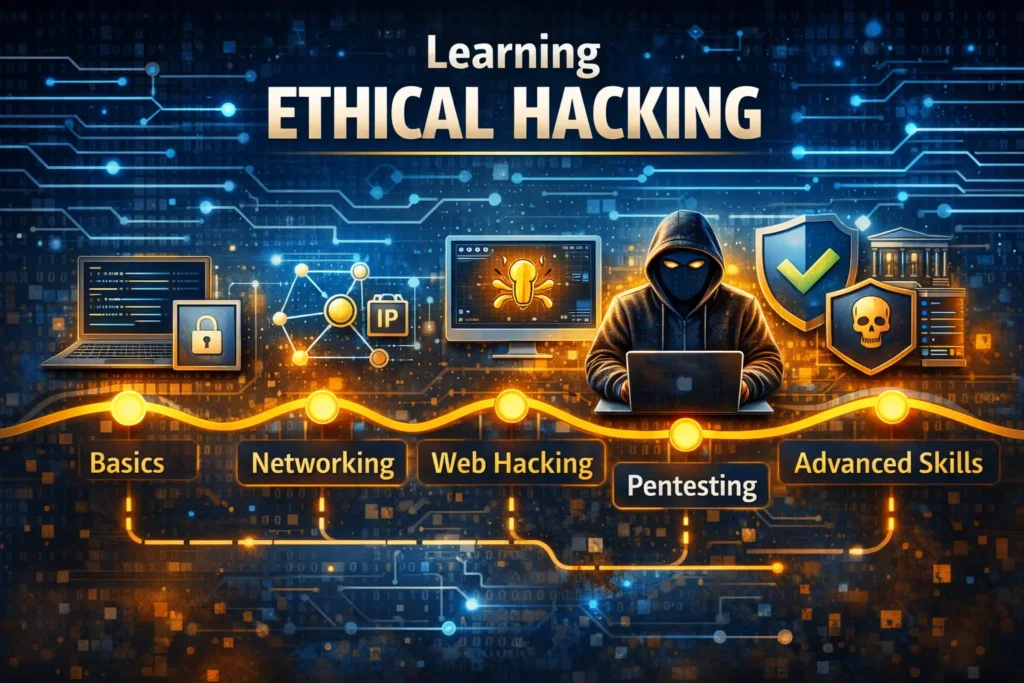
If you are a beginner and want to learn ethical hacking from scratch, the best approach is to follow a structured path. Trying to jump directly into advanced exploitation usually leads to confusion. Build your foundation first.
Step 1: Learn Basic Computer and Internet Concepts
Before everything else, become comfortable with operating systems, files, browsers, networks, and common internet concepts. Know how websites load, how email works, and how devices connect.
Step 2: Study Networking
Learn TCP/IP, subnets, DNS, HTTP, HTTPS, SSH, FTP, SMTP, ports, and firewalls. Practice basic command-line tools and learn how to inspect connectivity and traffic.
Step 3: Get Comfortable With Linux
Install a Linux environment and practice navigation, permissions, package installation, processes, logs, services, and shell commands. Many ethical hacking tasks become easier once Linux feels natural.
Step 4: Learn Basic Programming
Start with Python because it is beginner-friendly and very useful in cybersecurity. Learn variables, loops, conditions, functions, files, requests, and simple automation. Then add Bash and some JavaScript knowledge.
Step 5: Understand Web Application Basics
Many beginner labs focus on web vulnerabilities. Learn how forms work, how sessions behave, what cookies do, how authentication flows work, and how requests move between browser and server.
Step 6: Study Common Security Vulnerabilities
Start learning about SQL injection, cross-site scripting, broken authentication, access control problems, insecure deserialization, command injection, path traversal, file upload flaws, and weak configurations.
Step 7: Practice in Legal Labs
This is essential. Never practice on real websites or systems without permission. Use legal and safe platforms built for training, such as labs, virtual machines, practice ranges, and intentionally vulnerable applications.
Step 8: Learn Professional Tools Slowly
Do not collect tools without understanding them. Learn what each tool does, when to use it, and what its output means. Tools are assistants, not replacements for skill.
Step 9: Write Notes and Reports
Document every lab you solve. Record the vulnerability, how you found it, what evidence you captured, and how it can be fixed. This improves memory and prepares you for real work.
Step 10: Build a Portfolio
Over time, create a learning portfolio. It can include lab writeups, CTF experience, certifications, scripts, home labs, and summaries of what you learned. This helps when applying for internships or jobs.
Best Tools for Ethical Hacking
Ethical hacking involves many tools, but beginners should focus on understanding a few important ones rather than trying to learn everything at once.
Nmap
Nmap is widely used for network discovery and service scanning. It helps identify open ports, available services, and possible exposure points on hosts and networks.
Wireshark
Wireshark captures and analyzes network traffic. It is excellent for understanding packets, protocols, and suspicious communication patterns.
Burp Suite
Burp Suite is one of the most important tools for web application security testing. It helps inspect requests, modify parameters, replay traffic, and identify application weaknesses.
Metasploit
Metasploit is a popular framework for security testing and controlled exploitation. It can help validate vulnerabilities in lab and approved environments.
John the Ripper
This tool is used for password auditing and cracking in controlled settings. It helps demonstrate the risks of weak passwords.
Hashcat
Hashcat is another advanced password recovery and auditing tool often used in security testing labs.
Nikto
Nikto scans web servers for dangerous files, insecure configurations, and outdated software.
Gobuster
Gobuster helps discover directories, files, and virtual hosts during authorized web assessments.
As you progress, you will learn that tools matter, but understanding results matters even more.
Top Certifications for Ethical Hackers
Certifications are not everything, but they can help structure your learning and strengthen your credibility when applying for jobs or freelance work.
CEH (Certified Ethical Hacker)
CEH is well known and often recognized by employers. It gives beginners broad exposure to ethical hacking concepts, though practical skill still depends on hands-on work.
CompTIA Security+
This is a good entry-level security certification for people starting in cybersecurity. It covers broad security fundamentals and helps build a base.
eJPT
eJPT is popular among beginners who want more hands-on penetration testing exposure. It is often seen as practical and approachable.
OSCP
OSCP is one of the most respected practical certifications in offensive security. It is more advanced and requires serious lab work, persistence, and technical discipline.
CPTS or Similar Practical Paths
Some newer training paths focus strongly on practical assessment ability. These can be valuable if they include realistic labs and strong methodology.
For many beginners, the best route is to learn fundamentals first, build lab experience, then choose a certification that matches their level and goals.
Career Opportunities in Ethical Hacking
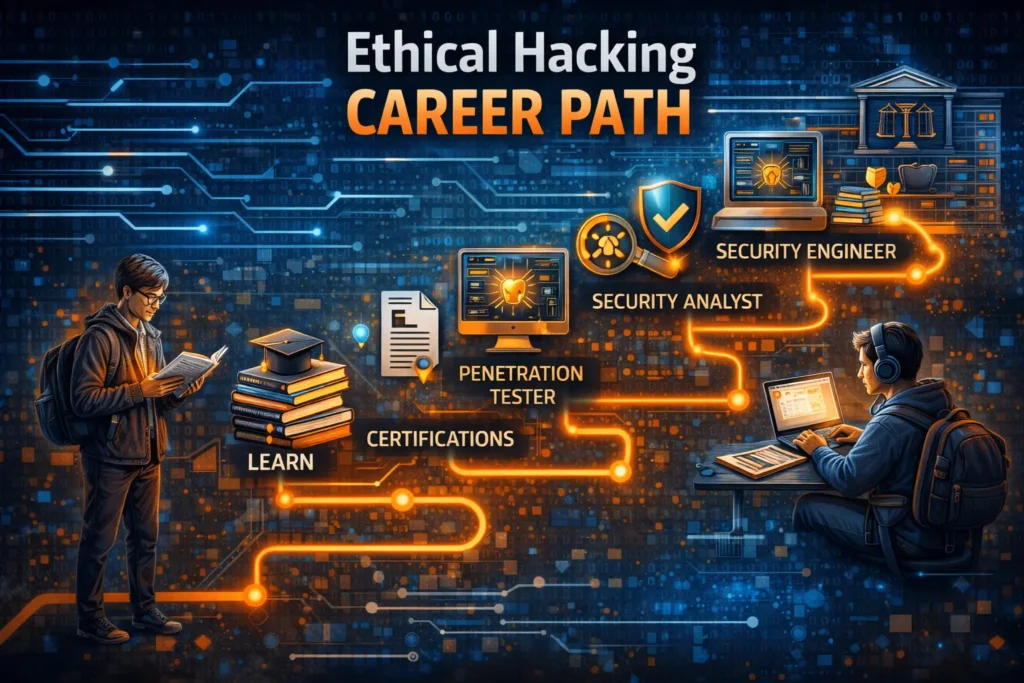
Ethical hacking can lead to many roles in cybersecurity. You may not start with the job title “ethical hacker” immediately, and that is normal. Many people enter through related technical positions and then specialize.
Common Career Paths
- Penetration Tester: Performs authorized security testing on applications, networks, and systems.
- Security Analyst: Monitors threats, investigates alerts, and supports defense operations.
- Vulnerability Analyst: Focuses on identifying, tracking, prioritizing, and helping remediate weaknesses.
- Security Consultant: Advises organizations on risk, testing, architecture, and security improvements.
- Red Team Operator: Simulates real-world attacks in highly controlled professional settings.
- Application Security Engineer: Works with developers to improve software security.
- Incident Responder: Helps investigate and contain active security events.
As digital systems grow, so does the demand for professionals who understand attack techniques and defense strategies. Ethical hacking can be an excellent long-term career for people who enjoy continuous learning.
Advantages and Disadvantages of Ethical Hacking
Advantages
- Strong global demand in cybersecurity
- Interesting work that combines investigation and technical skill
- Good earning potential over time
- Opportunity to work in-house, remotely, or as a consultant
- Constant learning keeps the field dynamic and future-relevant
Disadvantages
- Requires continuous learning because threats keep changing
- Can be mentally demanding and detail-heavy
- Legal and ethical boundaries must always be respected
- Beginners may feel overwhelmed by the wide range of topics
- Real mastery takes time, patience, and consistent practice
Even with challenges, ethical hacking remains one of the most exciting and valuable paths in modern technology.
Is Ethical Hacking Legal?
Yes, ethical hacking is legal only when it is authorized. This point is extremely important. You must have clear permission from the owner of the system before testing it. Without permission, even a harmless test can become illegal.
Professional ethical hacking usually happens under a written agreement or defined rules of engagement. These rules explain:
- What systems are in scope
- What methods are allowed
- What times testing can occur
- What types of impact must be avoided
- How findings should be reported
This is why beginners should train only in legal labs, self-owned environments, approved training platforms, or formal programs that clearly allow testing. Ethical hacking is respected because it operates responsibly and lawfully.
How Long Does It Take to Learn Ethical Hacking?
There is no single answer because learning speed depends on your background, consistency, time available, and the depth you want to reach. Still, a realistic view can help set expectations.
A beginner may understand the basics of ethical hacking within a few months if studying consistently. That includes foundational topics like networking, Linux, web basics, and common vulnerabilities. Reaching a strong intermediate level may take six to twelve months of focused learning and practice. Becoming highly skilled often takes one to two years or more, especially if you are building real hands-on ability rather than only reading theory.
The important thing is not speed alone. Ethical hacking rewards consistency. Daily practice, note-taking, repetition, and curiosity matter much more than rushing.
Common Mistakes Beginners Should Avoid
Many people become excited about ethical hacking and make avoidable mistakes early on. Knowing these can save time and frustration.
Skipping Fundamentals
Some beginners want to jump directly into advanced tools or exploits without learning networking, Linux, or web basics. This creates weak understanding and slow progress later.
Collecting Tools Without Understanding Them
Using many tools does not make someone skilled. Learn what each tool does and how to interpret its results.
Practicing on Unauthorized Targets
This is one of the worst mistakes. Never test real systems without permission. Stay inside legal labs and authorized environments.
Ignoring Documentation
Professional ethical hackers write clearly. If you do not document your findings, you are missing a core skill.
Expecting Fast Mastery
Ethical hacking takes time. Do not compare your day one to someone else’s year five. Focus on steady growth.
How to Build a Learning Plan for Ethical Hacking
A simple plan can help you stay focused. Instead of learning random topics every day, divide your progress into stages.
Month 1: Foundation
Learn networking basics, operating system basics, and command-line comfort. Spend time understanding how the web works.
Month 2: Linux and Web Basics
Practice Linux daily, understand HTTP requests, sessions, forms, cookies, and browser behavior.
Month 3: Programming and Security Concepts
Start Python and basic Bash. Learn common web vulnerabilities and security terminology.
Month 4: Practice Labs
Begin using safe labs and intentionally vulnerable applications. Focus on understanding, not speed.
Month 5 and Beyond: Tools, Reports, and Portfolio
Learn tools one by one, write your notes, build repeatable methodology, and prepare for an entry-level certification or portfolio milestone.
Even a simple plan like this can keep you consistent and prevent burnout.
Ethical Hacking vs Cybersecurity
Many beginners ask whether ethical hacking and cybersecurity are the same thing. The answer is no, but they are closely connected. Cybersecurity is the larger field that includes defense, monitoring, risk management, compliance, secure development, incident response, identity management, and more. Ethical hacking is one specialized part of cybersecurity focused on simulating attacks to test defenses.
So if you are learning ethical hacking, you are entering the wider world of cybersecurity. That is a positive thing because it gives you more career flexibility in the future.
For a broader understanding of online visibility and digital technology, you can also read our guides on SEO, digital marketing, and the metaverse.
Best Resources to Start Learning Ethical Hacking
Beginners often ask where to start. A good learning path usually combines theory, guided labs, documentation, and practice. You can learn from trusted resources such as OWASP, EC-Council, Cisco Networking Academy, NIST, and CompTIA. These sources are useful for understanding security principles, industry terminology, and professional learning paths.
When choosing resources, avoid sensational promises like “become a hacker in three days” or “master everything instantly.” Real ethical hacking is a professional discipline built on knowledge, legality, and practice.
FAQs About Ethical Hacking
What is ethical hacking in simple words?
Ethical hacking means testing computer systems legally to find security weaknesses before criminals can misuse them.
Can beginners learn ethical hacking?
Yes, beginners can learn ethical hacking by starting with networking, Linux, programming basics, and legal practice labs. A strong foundation makes later topics easier.
Do I need coding to learn ethical hacking?
You do not need advanced coding at the very beginning, but basic programming is very helpful. Python, Bash, JavaScript, and SQL are especially useful over time.
Is ethical hacking a good career?
Yes, ethical hacking is a strong career path because cybersecurity demand continues to grow. It can lead to roles in penetration testing, security analysis, application security, consulting, and more.
How long does it take to learn ethical hacking?
You can learn the basics in a few months with consistent study, but strong practical skill usually takes much longer. Many people build solid capability over one to two years of steady practice.
Which certification is best for ethical hacking?
That depends on your level. Beginners often start with Security+ or CEH-style learning, while more advanced learners may aim for practical certifications such as OSCP or similar hands-on paths.
Is ethical hacking legal?
Yes, but only when done with clear authorization and within the approved scope. Testing systems without permission can still be illegal.
Final Thoughts
Ethical hacking is more than learning a few tools or memorizing popular attacks. It is a professional cybersecurity discipline built on technical skill, legal authorization, responsible testing, and clear reporting. Ethical hackers help organizations discover weaknesses before criminals do, making them a critical part of modern digital defense.
For beginners, the best path is simple: start with fundamentals, learn networking, become comfortable with Linux, understand web technologies, study common vulnerabilities, and practice only in legal environments. Over time, add tools, certifications, methodology, and documentation skills. If you stay consistent, ethical hacking can become not only a valuable skill but also a long-term career with strong global demand.
If you are serious about entering technology, cybersecurity, or modern digital careers, learning ethical hacking is one of the smartest skills you can begin today.