

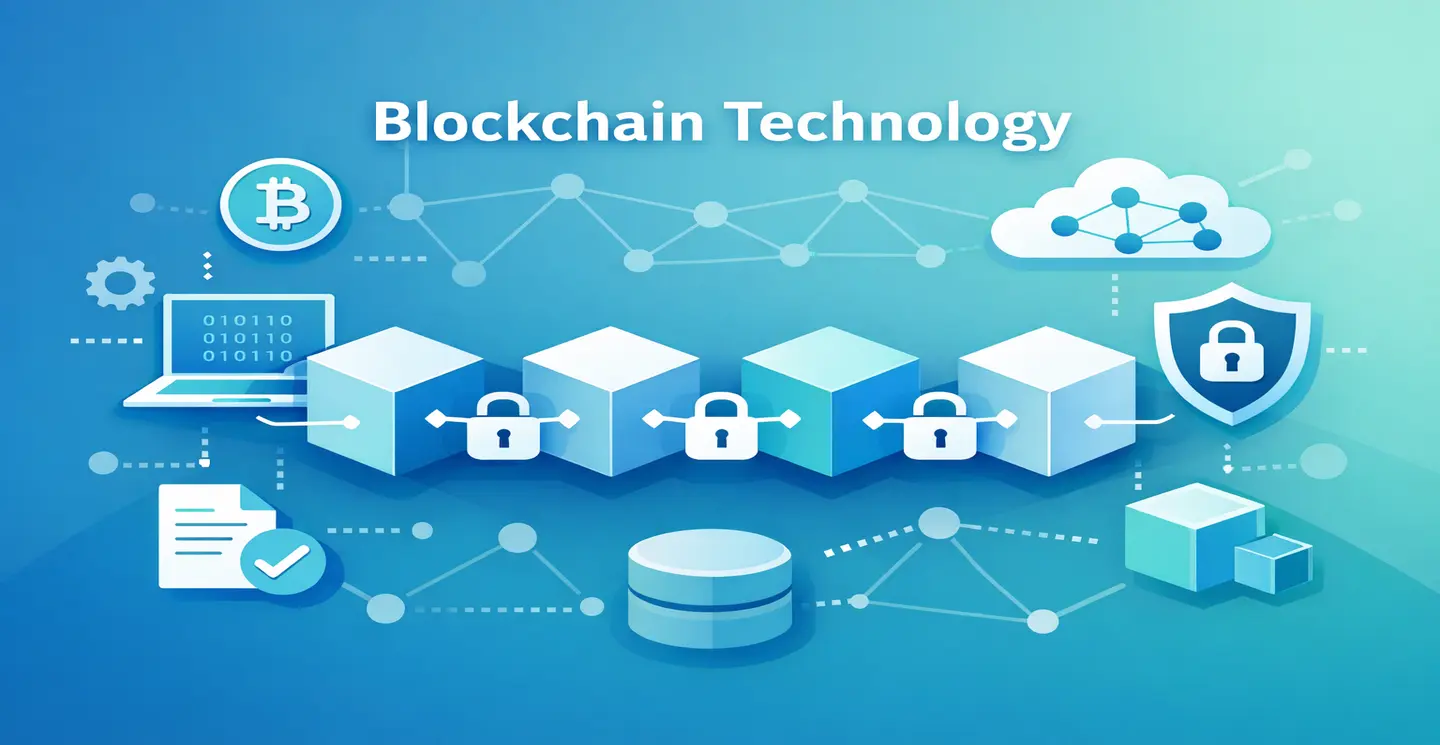
Blockchain technology has quietly evolved from a niche idea discussed among cryptographers into one of the most transformative technologies of the digital age. While many people associate blockchain only with cryptocurrencies, its real impact goes far beyond digital coins. From finance and healthcare to supply chains and cybersecurity, blockchain is reshaping how data is stored, verified, and trusted.
In this in-depth guide, we will explore what blockchain technology is, how it works step by step, why it is considered secure, and how it is being used in the real world today—all explained clearly and without unnecessary jargon.
Table of Contents
Understanding Blockchain Technology
At its core, blockchain technology is a distributed digital ledger that records information in a way that makes it extremely difficult to alter, hack, or manipulate.
Instead of storing data in a single centralized database (like traditional systems), blockchain distributes identical copies of data across a network of computers called nodes. Every participant in the network can verify the data independently, creating transparency and trust without the need for a central authority.
External DoFollow reference: IBM: What is blockchain?
Why Blockchain Was Created
Traditional digital systems rely on intermediaries—banks, governments, or centralized platforms—to verify transactions and maintain records. While this model works, it comes with problems:
- Single points of failure
- Data manipulation risks
- High transaction costs
- Limited transparency
Blockchain was designed to remove the need for trust in intermediaries by replacing it with mathematics, cryptography, and distributed consensus.
What Is a Block in Blockchain?
A block is a digital container that holds information. Each block typically includes:
- Transaction data – records of activity (payments, contracts, data changes)
- Timestamp – when the block was created
- Hash – a cryptographic fingerprint unique to the block
- Previous block hash – a reference to the block before it
These blocks are connected sequentially, forming a chain of blocks—hence the name blockchain.
How Blockchain Works: Step-by-Step
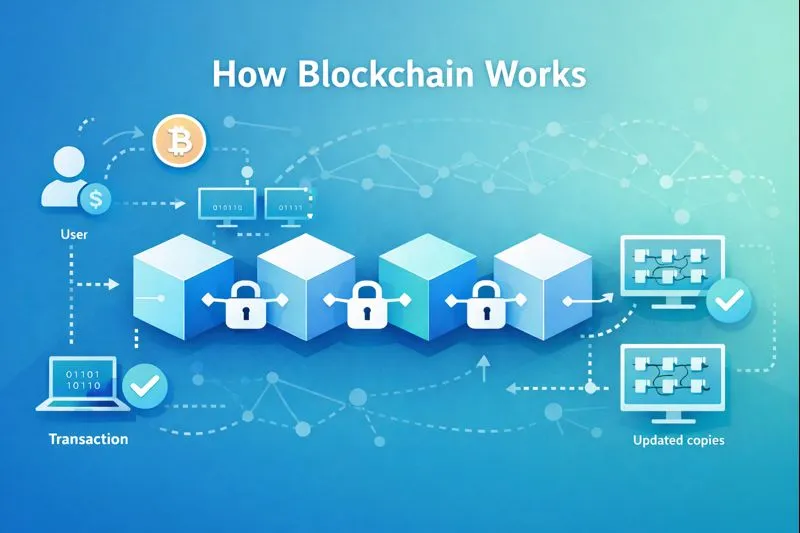
Let’s break down the blockchain process in simple steps:
1) Transaction Initiation
A user initiates a transaction—this could be sending cryptocurrency, updating a record, or executing a smart contract.
2) Transaction Broadcast
The transaction is broadcast to a peer-to-peer network of nodes.
3) Validation
Nodes verify the transaction using predefined rules, such as:
- Is the sender authorized?
- Is the data valid?
- Does it meet network requirements?
4) Block Creation
Once verified, the transaction is grouped with others into a new block.
5) Consensus Mechanism
The network agrees that the block is valid using a consensus algorithm.
6) Block Added to the Chain
The new block is cryptographically linked to the previous block and added permanently.
7) Ledger Update
All nodes update their copies of the ledger simultaneously.
External DoFollow reference: Investopedia: Blockchain
What Is Decentralization in Blockchain?
Decentralization means no single entity controls the network. Instead of relying on one central server, blockchain data is distributed across thousands of independent systems.
Benefits of Decentralization
- No single point of failure
- Higher resistance to censorship
- Greater transparency
- Reduced manipulation risk
For readers exploring foundational tech concepts, you may also like:
Blockchain Security: Why Is It So Hard to Hack?
Blockchain security is based on three pillars:
1) Cryptographic Hashing
Each block has a unique hash. Changing even one character in a block changes its hash entirely, instantly exposing tampering.
2) Distributed Copies
To alter data, an attacker would need to change more than 50% of all network copies simultaneously, which is computationally impractical for large blockchains.
3) Consensus Rules
Transactions must be approved by the network before being recorded.
Related security topic on LookPK:
Consensus Mechanisms Explained
Consensus mechanisms are how blockchain networks agree on which transactions are valid.
Proof of Work (PoW)
- Used by Bitcoin
- Requires solving complex mathematical problems
- Highly secure but energy-intensive
Proof of Stake (PoS)
- Used by many modern blockchains
- Validators are chosen based on staked assets
- Faster and more energy-efficient
External DoFollow reference: Ethereum: Consensus mechanisms
Types of Blockchain Networks
- Public blockchains – open to everyone (e.g., Bitcoin, Ethereum)
- Private blockchains – controlled by organizations; limited access
- Consortium blockchains – governed by a group of organizations
- Hybrid blockchains – mix of public and private features
Smart Contracts: The Brain of Blockchain
A smart contract is a self-executing digital agreement written in code. It runs automatically when predefined conditions are met—reducing delays, fraud, and administrative costs.
External DoFollow reference: Coursera: Smart contracts
Real-World Applications of Blockchain
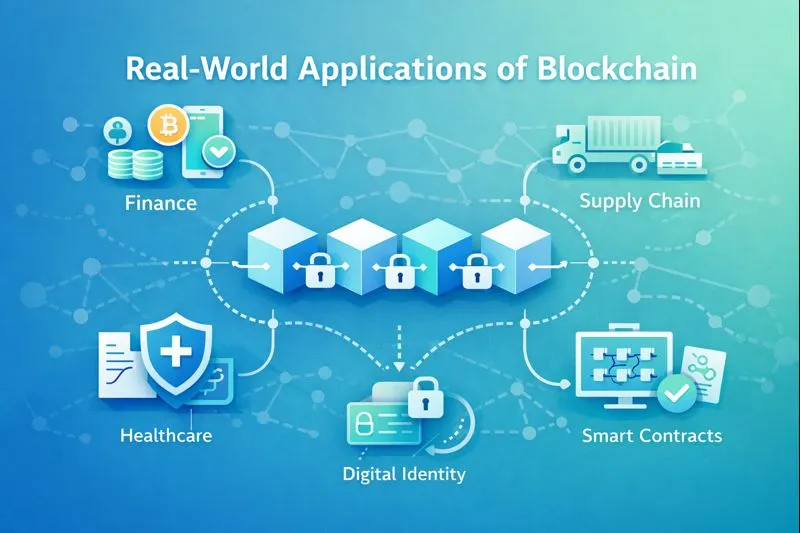
1) Cryptocurrencies
Blockchain enables secure peer-to-peer digital currencies without banks.
2) Supply Chain Management
Every step of a product’s journey can be recorded, improving transparency and traceability.
3) Healthcare
Patient records can be shared securely across providers while maintaining privacy.
4) Digital Identity
Blockchain can reduce identity fraud by giving users more control over their credentials.
5) Voting Systems
Transparent and tamper-resistant voting mechanisms are being explored in multiple pilots worldwide.
Advantages of Blockchain Technology
- High security and data integrity
- Transparency and auditability
- Reduced costs by minimizing intermediaries
- Faster settlement for specific use cases
- Trust without centralized control
Limitations and Challenges
- Scalability – high demand can slow networks
- Energy consumption – especially in PoW systems
- Regulatory uncertainty – varies by region
- Technical complexity – adoption requires skilled implementation
- Integration – legacy systems can be hard to connect
Blockchain vs Traditional Databases
| Feature | Blockchain | Traditional Database |
|---|---|---|
| Control | Decentralized | Centralized |
| Transparency | High | Limited |
| Security | Cryptographic + consensus | Admin-based controls |
| Data Editing | Immutable (typically) | Editable |
| Failure Risk | Lower (distributed) | Higher (single point) |
The Future of Blockchain Technology
Blockchain is expanding beyond cryptocurrencies into areas like Web3, decentralized finance (DeFi), tokenized assets, and secure digital infrastructure. As industries digitize, blockchain may become a foundational layer for verification and trust.
Related future-focused connectivity topic on LookPK:
FAQs
What is blockchain technology in simple words?
Blockchain technology is a shared digital record (ledger) stored across many computers, designed so data is hard to change and easy to verify.
How does blockchain work step by step?
A transaction is created, broadcast to a network, validated by nodes, grouped into a block, approved by consensus, and then added permanently to the chain.
Is blockchain the same as Bitcoin?
No. Bitcoin is a cryptocurrency that uses blockchain. Blockchain is the underlying technology that can be used for many applications beyond Bitcoin.
Why is blockchain considered secure?
It uses cryptographic hashes, distributed copies, and network consensus—making unauthorized changes extremely difficult.
What are smart contracts?
Smart contracts are self-executing agreements written in code that run automatically when conditions are met.