

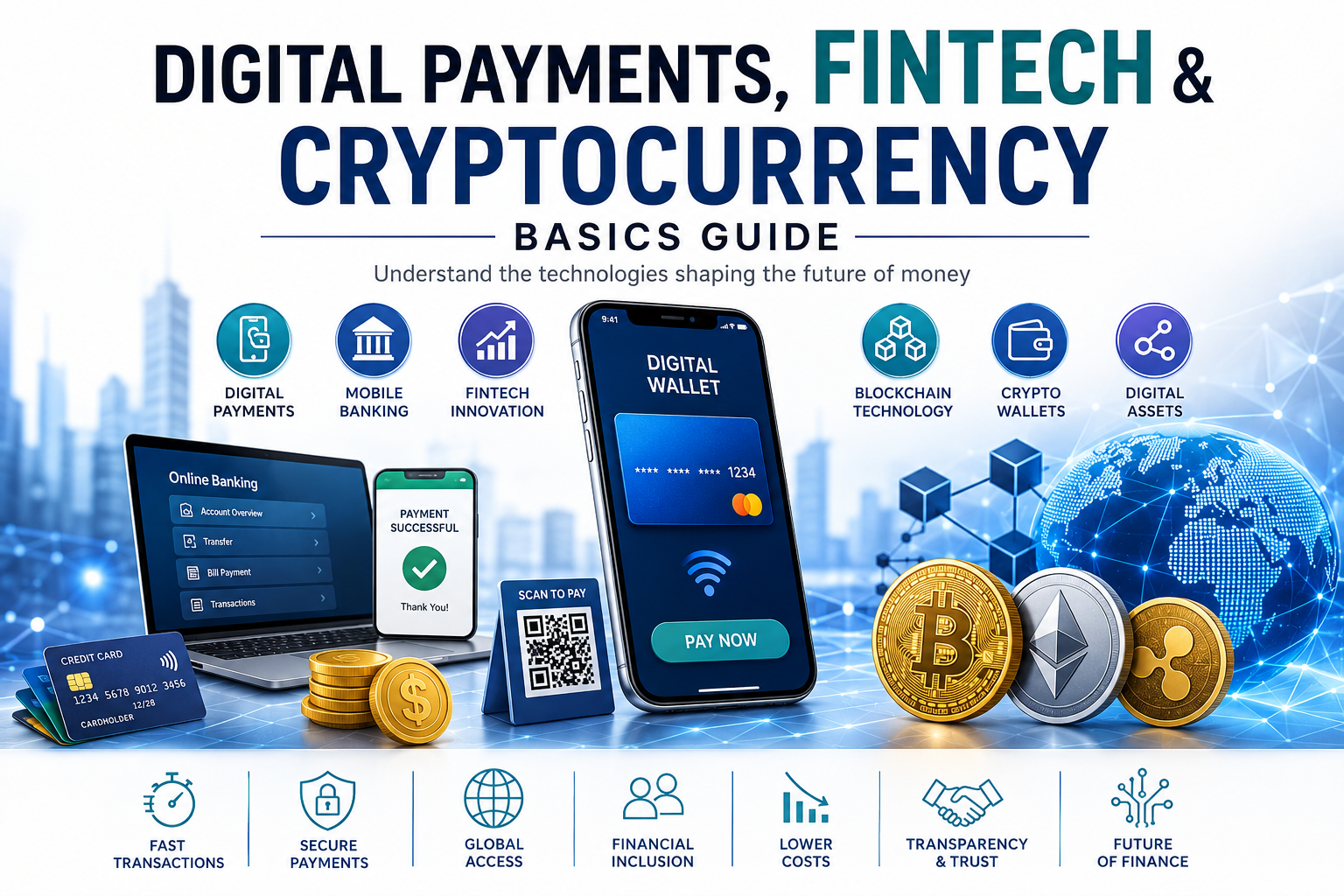
Money has evolved dramatically over the past few decades. What once required physical cash, paper checks, or visits to a bank branch can now be completed instantly through a smartphone. Today, people can transfer money, pay utility bills, shop online, invest in stocks, and even buy digital assets without leaving their homes. This financial transformation has been driven by three major developments: digital payments, Financial Technology (FinTech), and cryptocurrencies.
Understanding Digital Payments, FinTech & Cryptocurrency Basics is becoming increasingly important for students, professionals, entrepreneurs, and anyone interested in technology. These innovations are reshaping the global financial system and creating new opportunities for businesses and consumers alike.
Whether you are making an online purchase, using a banking app, scanning a QR code for payment, or hearing about Bitcoin and blockchain technology, you are already witnessing the future of finance in action. This guide explains everything in simple language so beginners can understand how modern financial technology works and why it matters.
Table of Contents
What Are Digital Payments?
Digital payments refer to financial transactions that take place electronically instead of using physical cash. When money moves between individuals, businesses, or institutions through digital channels, the transaction is considered a digital payment.
These payments can be completed through various technologies including mobile banking applications, online banking portals, debit cards, credit cards, digital wallets, payment gateways, and QR code systems.
For example, when you purchase a product from an online store and pay using your debit card, the transaction is processed electronically through a payment system. Similarly, when you transfer funds to a friend using a mobile banking application, you are using digital payment technology.
Common Examples of Digital Payments
- Online banking transfers
- Mobile banking applications
- Credit card transactions
- Debit card transactions
- QR code payments
- Digital wallets
- E-commerce payments
- Subscription payments
- Contactless card payments
- Peer-to-peer payment apps
Digital payments have become a central part of modern life because they offer convenience, speed, and accessibility that traditional cash transactions cannot provide.
Why Digital Payments Are Becoming More Popular
The rapid growth of digital payments is driven by technological advancements and changing consumer behavior. More people now have access to smartphones, internet connections, and online financial services than ever before.
Several factors have contributed to this growth:
- Widespread smartphone adoption
- Expansion of e-commerce platforms
- Faster internet connectivity
- Improved cybersecurity systems
- Convenient mobile applications
- Growth of contactless payment methods
- Increasing demand for instant transactions
Businesses also benefit from digital payment systems because they can process transactions more efficiently, reduce cash-handling costs, and serve customers globally.
The Evolution of Payment Systems
To understand the significance of digital payments, it helps to examine how payment systems have evolved throughout human history.
1. The Barter System
Thousands of years ago, people exchanged goods and services directly through barter. For example, a farmer might exchange wheat for livestock or tools.
Although simple, the barter system had limitations because both parties needed something the other wanted.
2. Physical Currency
Governments introduced coins and paper money to simplify trade. Physical currency became a standardized medium of exchange and supported economic growth.
3. Banking Systems
Banks allowed individuals and businesses to store money securely, transfer funds, and access financial services such as loans and savings accounts.
4. Electronic Payments
The introduction of computers and telecommunications enabled electronic banking, ATM cards, credit cards, and online transactions.
5. Digital Payments and Mobile Finance
Today, digital payments powered by smartphones, cloud computing, artificial intelligence, and financial technology platforms have transformed how people manage money.
What Is FinTech?
FinTech stands for Financial Technology. It describes the use of technology to improve, automate, and modernize financial services.
FinTech combines finance and technology to create smarter solutions for banking, payments, lending, insurance, investments, and financial management.
Instead of relying solely on traditional banks, consumers can now access many financial services through mobile applications and digital platforms.
FinTech companies focus on making financial services faster, cheaper, easier to use, and more accessible to a larger population.
Examples of FinTech Applications
- Mobile banking apps
- Online payment systems
- Digital wallets
- Investment platforms
- Personal finance applications
- Insurance technology platforms
- Peer-to-peer lending services
- Cryptocurrency exchanges
- Online trading platforms
- Financial analytics tools
Many of the financial services people use every day are powered by FinTech solutions.
Why FinTech Matters
Financial technology is transforming the financial industry by making services more efficient and accessible.
Traditionally, opening a bank account, applying for a loan, or investing money often required multiple visits to financial institutions. Today, many of these tasks can be completed within minutes using digital platforms.
FinTech helps consumers and businesses by:
- Reducing transaction times
- Improving customer experiences
- Lowering operational costs
- Increasing financial accessibility
- Providing real-time financial information
- Enhancing security and fraud detection
- Supporting financial inclusion
How FinTech Works
FinTech platforms rely on several advanced technologies that work together to deliver financial services efficiently.
Artificial Intelligence (AI)
Artificial intelligence helps financial institutions analyze data, detect fraudulent activities, automate customer support, and provide personalized financial recommendations.
To learn more about AI technologies, read our guide on What Is Generative AI? How ChatGPT Works.
Cloud Computing
Cloud computing enables financial companies to store data securely, scale services efficiently, and reduce infrastructure costs.
Cloud platforms make it possible for banks and financial companies to deliver services to millions of users simultaneously.
Related reading: What Is Cloud Computing?
Big Data Analytics
Financial organizations collect large volumes of information from transactions, customer interactions, and market activity. Big data analytics helps them understand patterns, assess risks, and improve decision-making.
Cybersecurity
Cybersecurity technologies protect financial systems from fraud, hacking attempts, malware, and unauthorized access.
Because financial data is highly sensitive, strong security measures are essential.
Learn more in our article on Cybersecurity: Importance and Types.
Blockchain Technology
Blockchain is one of the most important innovations in modern financial technology. It enables secure, transparent, and decentralized record keeping without relying entirely on traditional intermediaries.
Blockchain technology is also the foundation of many cryptocurrencies, which will be discussed in the next section of this guide.
Major Areas of FinTech
FinTech covers a wide range of financial services and technologies.
Digital Banking
Digital banking allows users to manage accounts, transfer funds, pay bills, and access financial services online without visiting a physical branch.
Digital Payments
Payment technologies help consumers and businesses send and receive money electronically through secure digital channels.
Online Lending
FinTech platforms allow borrowers to apply for loans online and receive faster approval decisions using automated assessment tools.
Investment Platforms
Digital investment applications make investing more accessible by allowing users to manage portfolios directly from their smartphones.
Insurance Technology (InsurTech)
Insurance technology uses automation and analytics to simplify policy management, claims processing, and customer service.
These innovations continue to reshape the global financial industry and create exciting opportunities for consumers, businesses, and future technology professionals.
Understanding Blockchain Technology
Blockchain technology is one of the most important innovations behind modern digital finance. It serves as the foundation for many cryptocurrencies and is increasingly being used in banking, supply chain management, healthcare, digital identity systems, and other industries.
A blockchain is a distributed digital ledger that records transactions across multiple computers. Instead of storing information in a single location, copies of the ledger exist across a network, making the system more secure and resistant to tampering.
Each transaction is stored inside a block. Once verified, that block is linked to previous blocks, creating a chain of records. This structure gives blockchain its name.
How Blockchain Works
- A user initiates a transaction.
- The transaction is broadcast to the network.
- Network participants verify the transaction.
- The verified transaction is grouped into a block.
- The block is added to the blockchain.
- The transaction becomes permanently recorded.
Because records are distributed and cryptographically secured, blockchain systems offer a high level of transparency and security.
Key Features of Blockchain
Transparency
Transactions can often be verified by network participants, increasing trust and accountability.
Security
Advanced cryptographic techniques help protect data from unauthorized modifications.
Decentralization
No single authority controls the entire blockchain network.
Immutability
Once information is recorded on the blockchain, altering it becomes extremely difficult.
What Is Cryptocurrency?
Cryptocurrency is a digital asset designed to function as a medium of exchange using cryptographic technology. Unlike traditional currencies issued by governments, many cryptocurrencies operate on decentralized blockchain networks.
The first and most famous cryptocurrency is Bitcoin, which was introduced in 2009. Since then, thousands of cryptocurrencies have been created, each with different features and purposes.
Cryptocurrencies allow users to transfer value digitally without always requiring traditional financial intermediaries.
How Cryptocurrency Transactions Work
When someone sends cryptocurrency, the transaction is submitted to the blockchain network. Network participants verify the transaction according to established rules. Once approved, the transaction becomes part of the blockchain and ownership is transferred to the recipient.
This process allows transactions to occur securely across global networks.
Popular Cryptocurrencies Explained
Bitcoin (BTC)
Bitcoin is the world’s first cryptocurrency and remains the largest by market value. Many investors view Bitcoin as a digital store of value and often refer to it as “digital gold.”
Bitcoin introduced the concept of decentralized digital money and inspired the development of thousands of other cryptocurrencies.
Ethereum (ETH)
Ethereum expanded blockchain functionality by introducing smart contracts. Smart contracts are self-executing agreements that run automatically when predetermined conditions are met.
Ethereum supports decentralized applications, blockchain games, NFTs, and decentralized finance platforms.
Solana (SOL)
Solana is known for its high transaction speed and relatively low fees. It has become popular among developers building blockchain applications that require scalability.
XRP
XRP focuses on facilitating fast international payments and cross-border financial transactions. It aims to improve efficiency in global payment networks.
Cardano (ADA)
Cardano emphasizes scientific research, sustainability, and peer-reviewed development methods. It aims to provide a secure and scalable blockchain platform.
What Is a Crypto Wallet?
A crypto wallet is a tool that allows users to access and manage cryptocurrency holdings. Contrary to popular belief, crypto wallets do not actually store coins. Instead, they store the private and public keys that provide access to blockchain assets.
Hot Wallets
Hot wallets are connected to the internet and provide convenient access to cryptocurrencies.
- Mobile wallets
- Desktop wallets
- Web wallets
- Exchange wallets
Advantages include convenience and fast access. However, internet connectivity can expose them to greater security risks.
Cold Wallets
Cold wallets remain offline and are generally considered more secure for long-term storage.
- Hardware wallets
- Paper wallets
- Offline storage devices
Cold storage reduces exposure to online threats but may be less convenient for frequent transactions.
Advantages of Cryptocurrency
- Global accessibility
- Fast international transfers
- Potentially lower transaction costs
- Decentralized ownership
- Financial innovation
- Blockchain transparency
- 24/7 transaction capability
These advantages have attracted interest from investors, businesses, developers, and financial institutions worldwide.
Risks of Cryptocurrency
While cryptocurrency offers exciting possibilities, users must also understand the risks involved.
- Price volatility
- Regulatory uncertainty
- Scams and fraud
- Phishing attacks
- Loss of wallet credentials
- Technical complexity
- Irreversible transactions
Beginners should invest time in learning before making financial decisions related to cryptocurrencies.
What Is a Digital Wallet?
A digital wallet stores payment information electronically and allows users to make transactions using smartphones, computers, or other connected devices.
Digital wallets can be used for online shopping, in-store purchases, bill payments, and peer-to-peer transfers.
Benefits of Digital Wallets
- Convenient payments
- Reduced reliance on cash
- Fast transactions
- Improved expense tracking
- Enhanced security features
What Is a Payment Gateway?
A payment gateway is a technology that securely processes online payments between customers, businesses, and financial institutions.
Whenever a customer enters payment information during an online purchase, the payment gateway encrypts and transmits the data securely for authorization.
How Payment Gateways Work
- Customer enters payment information.
- Payment gateway encrypts the data.
- Information is sent for authorization.
- The transaction is approved or declined.
- Funds are transferred accordingly.
Payment gateways are essential for e-commerce websites and digital businesses worldwide.
Digital Banking Explained
Digital banking enables customers to perform banking activities online using websites and mobile applications.
Services commonly offered through digital banking include:
- Account management
- Fund transfers
- Bill payments
- Loan applications
- Transaction history
- Account alerts
- Mobile deposits
Digital banking improves convenience by reducing the need to visit physical branches.
Career Opportunities in FinTech
As financial technology continues to grow, organizations require skilled professionals who understand both finance and technology.
FinTech Developer
Develops software applications for digital financial services.
Blockchain Developer
Designs blockchain networks, smart contracts, and decentralized applications.
Cybersecurity Specialist
Protects financial systems from cyber threats and data breaches.
Data Analyst
Analyzes financial data to support business decisions and risk management.
Digital Banking Specialist
Supports and manages digital banking operations and customer experiences.
Financial Product Manager
Leads the development of financial products and services.
How Students Can Start Learning FinTech
Students interested in financial technology can begin building their knowledge gradually.
- Learn basic financial concepts.
- Understand banking systems.
- Study digital payment methods.
- Learn networking fundamentals.
- Explore programming languages.
- Understand cybersecurity basics.
- Study blockchain technology.
- Follow industry developments.
Networking knowledge is especially valuable because financial systems depend on secure communication networks. Our article on the OSI Model can help beginners understand how network communication works.
Students interested in future technologies may also enjoy reading our article about Robotics & Automation Future Careers, which explores how technology is creating new professional opportunities across industries.
Future of Digital Payments
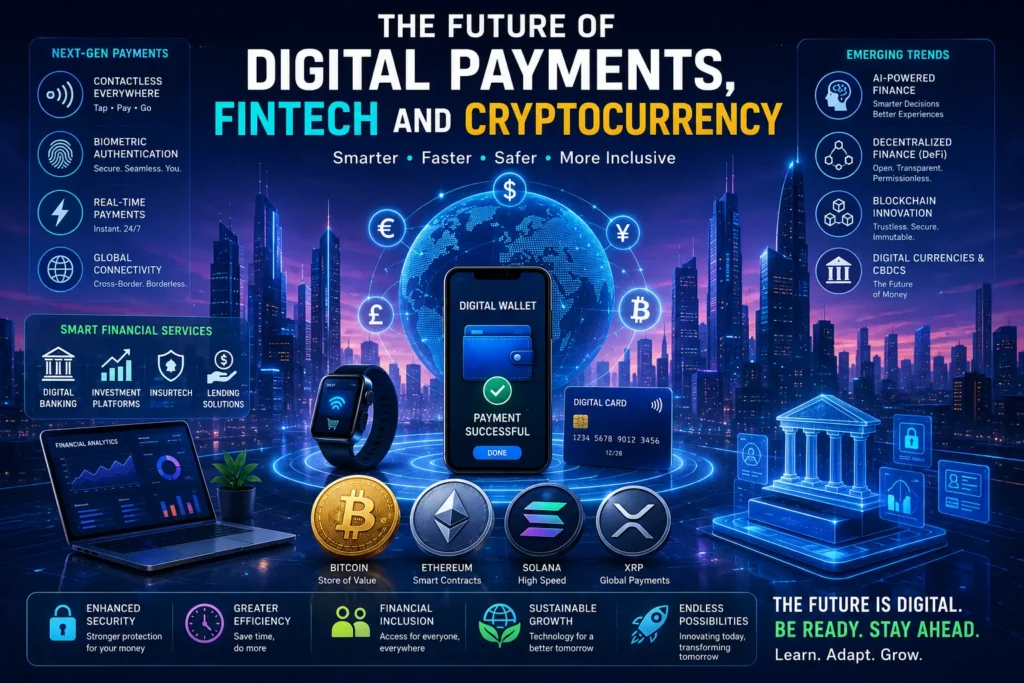
The future of digital payments is expected to be faster, smarter, and more secure. As technology continues to evolve, payment systems are becoming more integrated into everyday life. Consumers increasingly expect instant transactions, seamless user experiences, and stronger security protections.
Several emerging trends are shaping the future of digital payments worldwide.
Contactless Payments
Contactless payment technology allows users to complete transactions simply by tapping a card, smartphone, or wearable device near a payment terminal. This method is becoming increasingly popular because it is fast, convenient, and secure.
Biometric Authentication
Biometric technologies such as fingerprint recognition, facial recognition, and voice authentication are expected to play a larger role in payment verification. These technologies can enhance security while reducing the need for passwords.
Real-Time Payments
Many countries are investing in payment infrastructures that enable instant fund transfers. Real-time payment systems allow money to move between accounts within seconds rather than hours or days.
Cross-Border Digital Payments
International payments are often expensive and slow. Future payment technologies aim to reduce transaction costs and processing times, making global commerce more efficient.
According to the World Bank, digital financial services are helping expand financial inclusion and provide banking access to millions of people worldwide.
Future of FinTech
Financial technology continues to evolve rapidly. New innovations are transforming how businesses and consumers interact with financial services.
Artificial Intelligence in Finance
Artificial intelligence will continue improving fraud detection, customer support, investment analysis, credit scoring, and financial planning. AI-powered systems can analyze large volumes of information and help organizations make better decisions.
Open Banking
Open banking allows financial institutions to securely share data with authorized third-party providers. This can lead to more personalized financial products and better customer experiences.
Embedded Finance
Embedded finance integrates financial services directly into non-financial platforms. For example, customers may access lending, insurance, or payment options directly within e-commerce applications.
Financial Inclusion
FinTech solutions are helping bring financial services to underserved populations worldwide. Mobile technologies can provide banking access to people who previously lacked traditional financial infrastructure.
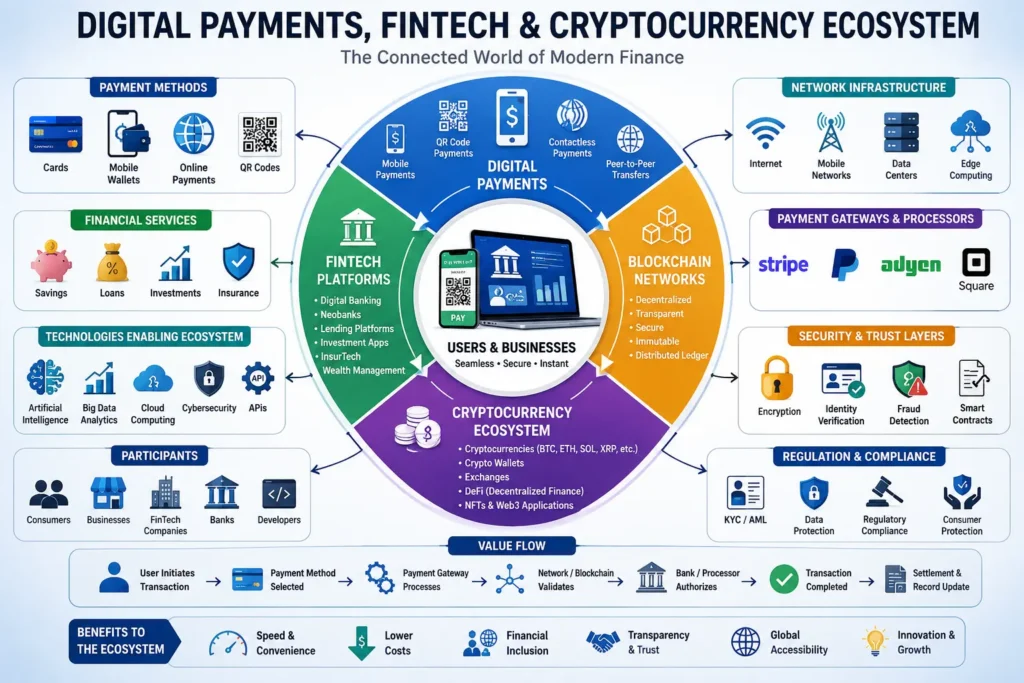
The International Monetary Fund (IMF) regularly publishes research on financial technology, digital banking, and emerging payment systems.
Future of Cryptocurrency
Cryptocurrency remains one of the most discussed innovations in financial technology. While adoption levels vary across countries, interest in blockchain-based assets continues to grow among businesses, investors, governments, and technology companies.
Institutional Adoption
Large organizations are increasingly exploring blockchain technology and digital assets. Some financial institutions are investigating how blockchain can improve efficiency, transparency, and security.
Improved Regulation
Governments and regulators around the world are working to establish clearer frameworks for cryptocurrency activities. Improved regulations may help increase consumer protection and encourage responsible innovation.
Central Bank Digital Currencies (CBDCs)
Many central banks are researching digital versions of national currencies. These systems, often called Central Bank Digital Currencies, aim to combine the efficiency of digital payments with the stability of government-issued money.
Decentralized Finance (DeFi)
Decentralized Finance refers to blockchain-based financial services that operate without traditional intermediaries. Although still developing, DeFi has introduced innovative approaches to lending, borrowing, trading, and asset management.
The Bank for International Settlements (BIS) studies blockchain technology, digital currencies, and the future of global payment infrastructure.
Challenges Facing Digital Finance
Despite its rapid growth, digital finance faces several important challenges.
Cybersecurity Threats
Financial platforms are attractive targets for cybercriminals. Organizations must continuously improve security measures to protect sensitive information and customer assets.
Privacy Concerns
As financial transactions become increasingly digital, protecting user privacy remains a critical priority.
Regulatory Compliance
Financial service providers must comply with numerous laws and regulations. Balancing innovation with consumer protection remains an ongoing challenge.
Financial Literacy
Many people still lack a strong understanding of digital finance. Education plays an essential role in helping users make informed decisions and avoid scams.
Why Students Should Learn Digital Finance
Digital finance is becoming a fundamental part of modern society. Students who understand digital payments, FinTech, blockchain technology, and cryptocurrencies will be better prepared for future careers and technological advancements.
Knowledge of digital finance can benefit students in many fields, including technology, business, banking, economics, cybersecurity, software development, data science, and entrepreneurship.
As industries become increasingly digital, understanding financial technology may become as important as understanding the internet itself.
Conclusion
Digital Payments, FinTech & Cryptocurrency Basics represent some of the most important developments in modern technology and finance. Digital payments make transactions faster and more convenient. FinTech is transforming how financial services are delivered. Cryptocurrency and blockchain technology are introducing entirely new ways to store, transfer, and manage value.
For beginners and students, understanding these concepts provides valuable insight into the future of money and technology. Whether you pursue a career in finance, software development, cybersecurity, artificial intelligence, or business, knowledge of digital finance will become increasingly valuable in the years ahead.
The financial world is becoming more connected, digital, and technology-driven. Learning these fundamentals today can help prepare you for tomorrow’s opportunities.
Frequently Asked Questions (FAQs)
What are digital payments?
Digital payments are electronic transactions conducted without physical cash using cards, mobile apps, online banking, digital wallets, or payment gateways.
What does FinTech mean?
FinTech stands for Financial Technology and refers to the use of technology to improve financial services such as banking, payments, investing, lending, and insurance.
What is cryptocurrency?
Cryptocurrency is a digital asset that uses cryptography and blockchain technology to enable secure transactions.
What is blockchain?
Blockchain is a distributed digital ledger that records transactions across multiple computers in a secure and transparent manner.
What is a crypto wallet?
A crypto wallet stores the digital keys required to access and manage cryptocurrency assets.
Is cryptocurrency safe?
Cryptocurrency can be used safely when proper security practices are followed, but it also involves risks such as scams, volatility, and loss of wallet access.
Is FinTech a good career?
Yes. FinTech offers strong career opportunities in software development, cybersecurity, blockchain, artificial intelligence, digital banking, and data analytics.
Can students learn blockchain technology?
Absolutely. Students can start by learning networking, cybersecurity, databases, programming, and blockchain fundamentals.