
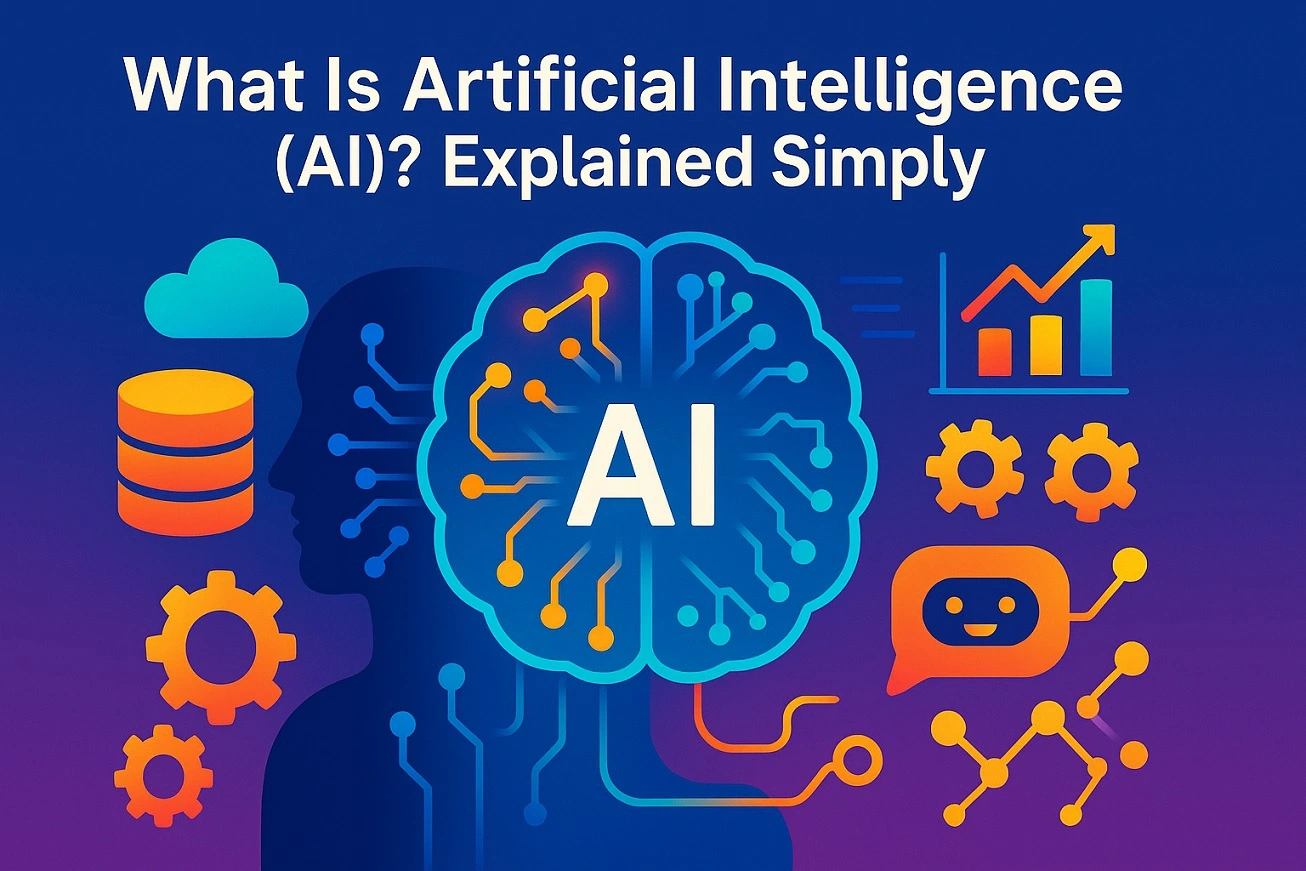
If you have ever searched “What Is Artificial Intelligence (AI)? Explained Simply”, you are not alone. Students, professionals, and beginners all want a clear, easy answer. Artificial Intelligence (AI) is the technology that allows computers and machines to perform tasks that usually require human intelligence, such as learning, reasoning, problem-solving, and decision-making.
In this beginner-friendly guide, we will break down what Artificial Intelligence is, how it works, types of AI, real-life examples, benefits, risks, and its future. By the end, the question “What Is Artificial Intelligence (AI)?” will feel simple and practical, not confusing or technical.
Table of Contents
What Is Artificial Intelligence (AI) in Simple Words?
To really understand What Is Artificial Intelligence (AI)?, imagine teaching a child to recognize a cat. You show many pictures and say, “This is a cat.” After some time, the child learns the pattern and can recognize a cat alone.
Artificial Intelligence works in a similar way.
- You give a computer thousands of examples (data).
- The computer uses algorithms to study these examples.
- It finds patterns inside the data.
- Next time it sees something similar, it can say, “This is a cat,” “This email is spam,” or “This customer is likely to buy.”
In simple words, Artificial Intelligence (AI) is the ability of a computer or machine to learn from data, understand patterns, and make smart decisions with minimal human help.
So when someone asks “What Is Artificial Intelligence (AI)? Explained Simply”, the shortest answer is: AI makes machines smart enough to learn and act like humans in specific tasks.
How Does Artificial Intelligence Work?
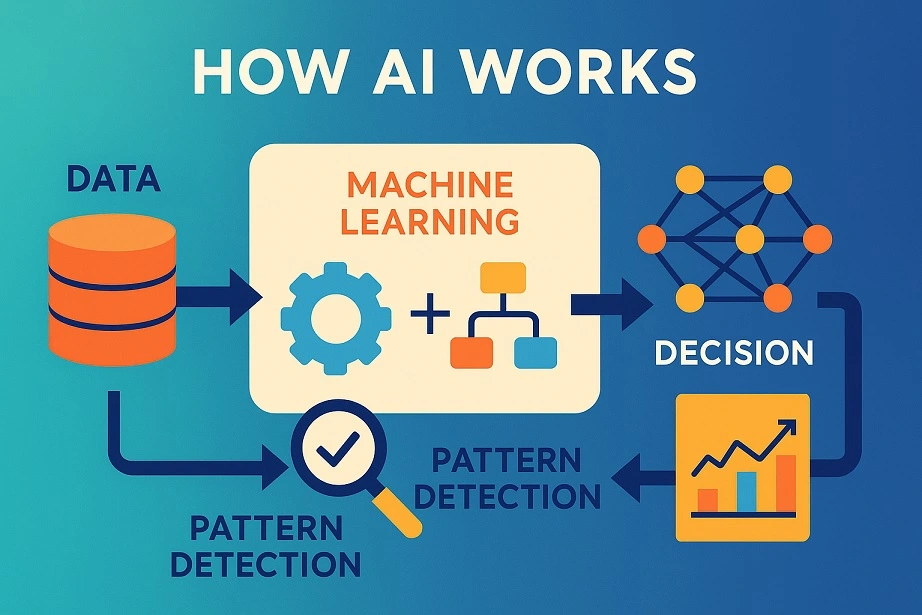
Now that we know what Artificial Intelligence is, let’s see how it works behind the scenes. Most modern AI is based on a process called machine learning. Instead of being programmed with step-by-step rules, the system learns from data.
- Data Collection: The AI system collects data such as images, text, numbers, audio, or video.
- Training the Model: Algorithms are used to train a model on this data. The model learns the relationship between inputs and outputs.
- Pattern Recognition: The trained model recognizes patterns, such as faces in photos, fraud in transactions, or objects on the road.
- Prediction & Decision: When new data arrives, the AI uses what it has learned to make predictions or decisions.
Two important ideas that often appear when people search “What Is Artificial Intelligence (AI)? Explained Simply” are machine learning and deep learning:
- Machine Learning: The computer learns from data using algorithms that improve with experience.
- Deep Learning: A special kind of machine learning that uses layered artificial “neurons,” inspired by the human brain, to solve complex problems like image and speech recognition.
Everyday Examples of Artificial Intelligence
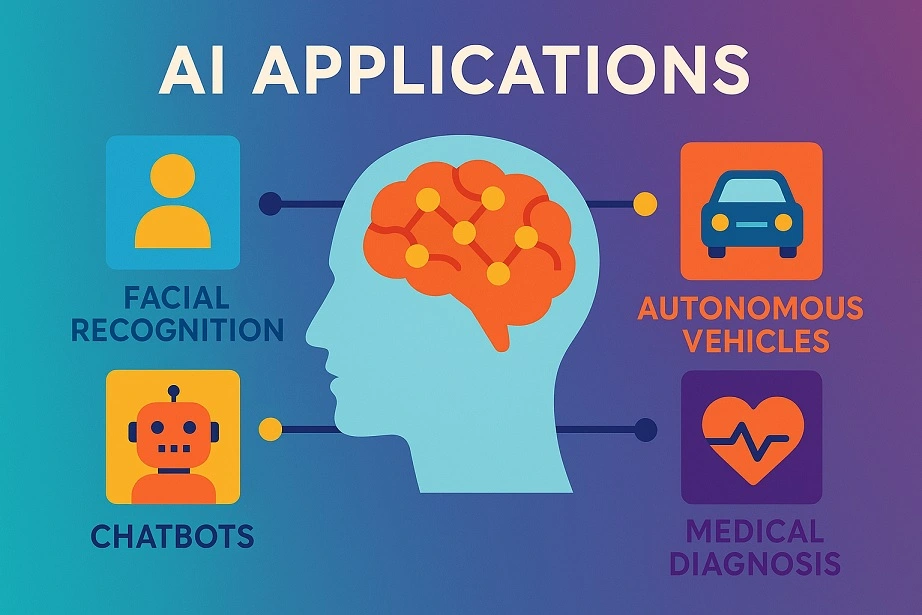
To fully answer What Is Artificial Intelligence (AI)? we must look at real-life examples. AI is already around you, even if you don’t notice it.
- Smartphones: Face unlock, camera scene detection, auto-correct, and voice typing.
- Search Engines: Google uses AI to understand your queries and show relevant results.
- Chatbots & Virtual Assistants: Tools like ChatGPT, Siri, Alexa, and Google Assistant respond to your voice or text using AI.
- Social Media: AI chooses which posts, videos, and reels appear on your feed on YouTube, TikTok, Instagram, and Facebook.
- Maps & Navigation: Google Maps uses AI to suggest the fastest route and predict traffic.
- E-commerce: Online stores use AI to recommend products based on your behavior.
In professional fields, Artificial Intelligence is used in:
- Healthcare: Early disease detection, medical image analysis, and personalized treatment.
- Finance: Fraud detection, risk analysis, algorithmic trading, and credit scoring.
- Education: Personalized learning paths and smart tutoring systems.
- Manufacturing: Quality control, robotics, and predictive maintenance of machines.
Main Types of Artificial Intelligence
Another common part of the question “What Is Artificial Intelligence (AI)? Explained Simply” is understanding its main types. One easy way is to divide AI by capability.
1. Narrow AI (Weak AI)
Narrow AI is designed to do one specific task very well. It cannot do everything a human can do; it is limited to one area.
- Face recognition on your phone
- Spam filter in your email
- Voice assistants like Siri or Alexa
- Recommendation systems on Netflix or YouTube
Almost all the AI that exists today is Narrow AI.
2. General AI (Strong AI)
General AI would be a system that can understand, learn, and perform any intellectual task that a human can. It would be like a digital human brain.
However, General Artificial Intelligence does not exist yet. It is still a long-term goal in research, and one of the reasons people keep asking What Is Artificial Intelligence (AI)? and where it might go in the future.
3. Superintelligent AI
Superintelligent AI refers to a hypothetical system that is smarter than all humans combined. This is the type of AI often shown in science-fiction movies that control the world.
Right now, superintelligent AI is only a theoretical idea and a topic for ethical debate, not a reality.
Core Technologies Behind Artificial Intelligence
To explain What Artificial Intelligence (AI) is more deeply, we should also know about the main technologies used to build AI systems:
- Machine Learning (ML): Algorithms that learn from data and improve automatically.
- Deep Learning: Multi-layer neural networks that handle complex tasks such as image classification and speech recognition.
- Natural Language Processing (NLP): Allows computers to understand and generate human language. This article you are reading is analyzed by NLP when tools check keyword density.
- Computer Vision: Lets machines understand photos and videos.
- Robotics: Combines mechanical design with AI algorithms to create smart robots.
Benefits of Artificial Intelligence
When you ask “What Is Artificial Intelligence (AI)? Explained Simply”, you also want to know why it is important. Here are some key benefits:
- Automation of Repetitive Tasks: AI can handle routine or boring work faster and with fewer mistakes.
- Better Decision-Making: AI analyzes large amounts of data to help people and organizations make smarter choices.
- 24/7 Availability: Chatbots and virtual assistants can work all day without breaks.
- Improved Accuracy: In fields like medical diagnosis or quality control, AI can detect tiny patterns that humans may miss.
- Cost Savings: Automation and optimization reduce long-term operating costs.
Challenges and Risks of Artificial Intelligence
No explanation of What Is Artificial Intelligence (AI) is complete without discussing its risks. While AI is powerful, it also brings challenges that must be handled carefully:
- Job Displacement: Some repetitive or low-skill jobs may be replaced by automated systems.
- Bias and Fairness: If AI is trained on biased data, it can produce unfair or discriminatory results.
- Privacy Concerns: AI systems often use large volumes of personal data, raising privacy and security issues.
- Misuse of AI: Deepfakes, fake news generation, and automated cyber-attacks are examples of harmful uses.
- Lack of Transparency: Some advanced AI models are “black boxes,” making it hard to explain how they reached a decision.
Because of these issues, many organizations now focus on ethical AI, transparent algorithms, and responsible data use.
The Future of Artificial Intelligence
People who search “What Is Artificial Intelligence (AI)? Explained Simply” are often also curious about the future of AI. While nobody can predict everything, we can expect:
- More personalized education with AI-powered learning platforms.
- Smarter healthcare systems that can predict diseases earlier.
- More efficient smart cities with intelligent traffic, energy, and waste management.
- Advanced autonomous vehicles and delivery drones.
- New categories of AI-related jobs that do not exist today.
AI will not completely replace humans, but humans who understand What Artificial Intelligence is and how to use it will have a strong advantage in the future job market.
Artificial Intelligence for Students and Beginners
If you are a student or a beginner, this is the perfect time to learn What Is Artificial Intelligence (AI) and how it can help your career. You do not need to be a maths genius to start. Begin with basic concepts and grow step by step.
Good starting points include:
- Learning basic programming (Python is very popular in AI).
- Understanding data types, statistics, and logic.
- Taking beginner-friendly online courses on AI and machine learning.
- Experimenting with simple AI tools, apps, or platforms.
With consistent effort, you can move from simply asking “What Is Artificial Intelligence (AI)? Explained Simply” to actually building basic AI projects yourself.
Internal Links (LookPK Resources)
To continue learning about technology, security, and digital skills, you can also read these resources on LookPK:
Helpful External Resources to Learn More About AI
If you want to go deeper after this simple explanation of What Artificial Intelligence is, here are some trusted learning resources:
- IBM – What is Artificial Intelligence?
- Microsoft – AI for Beginners
- Google – Machine Learning Crash Course
Conclusion: What Is Artificial Intelligence (AI)? Explained Simply
We started with the question “What Is Artificial Intelligence (AI)? Explained Simply” and discovered that AI is not magic. It is a powerful technology that uses data and algorithms to help machines learn, recognize patterns, and make intelligent decisions.
From recommendation systems and voice assistants to self-driving cars and medical tools, Artificial Intelligence is shaping how we live, work, and learn. Understanding What Artificial Intelligence is and how it works is becoming as important as knowing how to use the internet or a smartphone.
Whether you are a student, a professional, or just curious, this is the right time to explore AI, build your digital skills, and be ready for a future where humans and intelligent machines work together.