
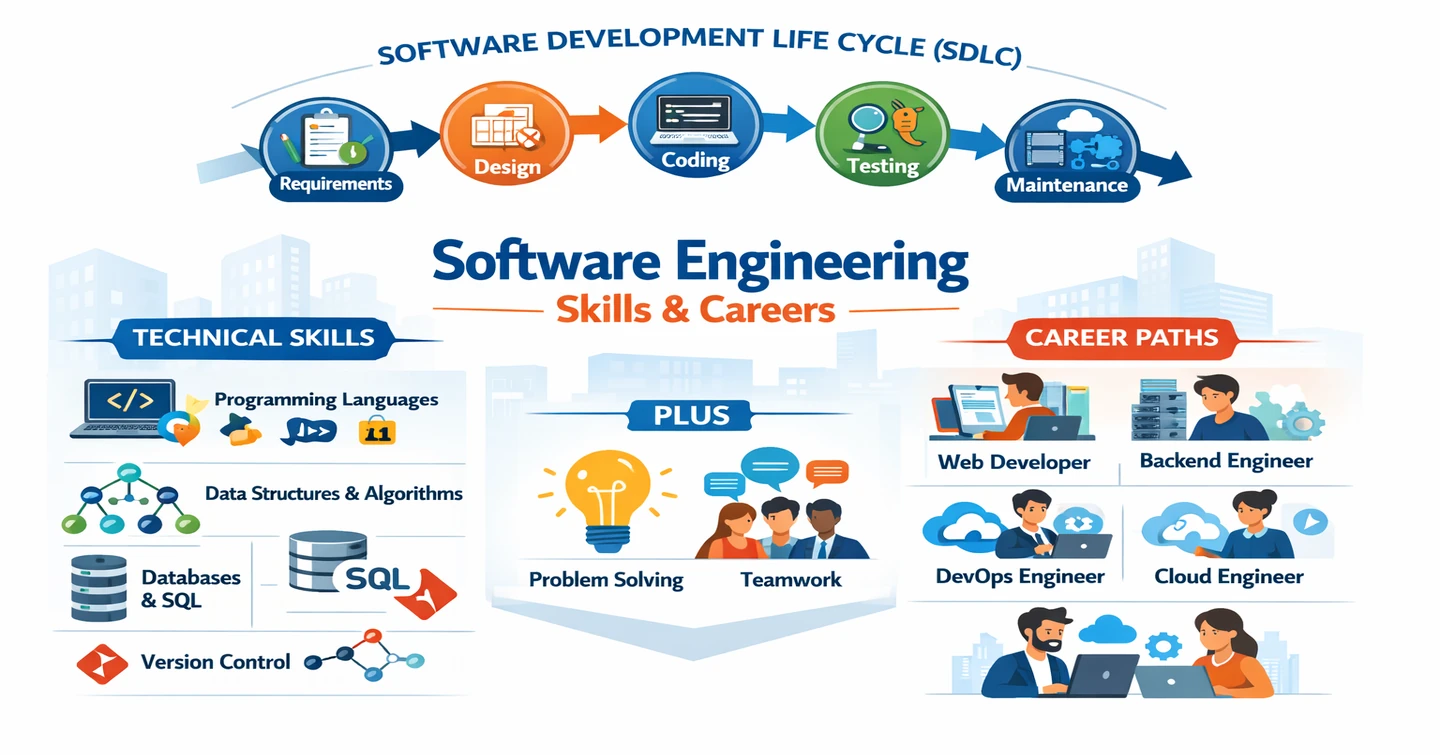
Software engineering is one of the most important—and most misunderstood—fields in modern technology. Many beginners think it means “just coding.” In reality, software engineering is the disciplined process of designing, building, testing, deploying, and maintaining software that stays reliable under real-world use.
From banking apps to hospital systems, flight software to e-commerce platforms, software runs the world. And when software fails, the damage can be expensive—or even dangerous. That’s why software engineering follows structured methods, quality standards, and professional practices used across the industry.
Table of Contents
What Is Software Engineering?
Software engineering is the systematic and professional approach to creating software systems using engineering principles—so the software is maintainable, scalable, secure, and reliable.
The IEEE Computer Society maintains professional guidance and bodies of knowledge for software engineering (including SWEBOK), which is widely used in education and industry. You can explore the overview here: Software Engineering Body of Knowledge (SWEBOK) – IEEE Computer Society.
For a beginner-friendly baseline definition, Wikipedia provides a helpful starting point: Software Engineering (Wikipedia).
Simple idea: A programmer may write code that works today. A software engineer builds systems that can survive real users, real traffic, real change, and real risk.
Software Engineering vs Programming (Beginner-Friendly)
This is a common confusion. Programming is part of software engineering, but software engineering is bigger.
| Programming | Software Engineering |
|---|---|
| Writing code | Designing and delivering complete systems |
| Focus on syntax and implementation | Focus on architecture, quality, and long-term maintenance |
| Can be solo | Usually team-based |
| Short-term output | Full software lifecycle responsibility |
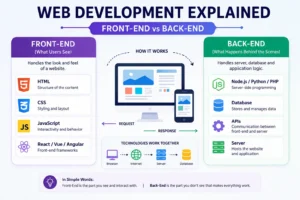
If you’re also learning web development, this LookPK guide will help you understand the system split clearly: Web Development Explained: Front-End vs Back-End.
Why Software Engineering Matters Today
Modern software is not a “small script.” It’s a living product that must handle:
- Millions of users
- Security threats and attacks
- Frequent updates and feature changes
- Multiple devices and platforms
- Legal, privacy, and ethical responsibilities
That’s why professional standards exist. For example, ISO/IEC/IEEE 12207 describes software life cycle processes used to define and improve development practices: ISO/IEC/IEEE 12207:2017 – Software Life Cycle Processes.
Software engineering is also a responsibility-driven profession. The ACM/IEEE Software Engineering Code of Ethics is a strong reference for professional conduct: ACM/IEEE Software Engineering Code of Ethics.
Software Development Life Cycle (SDLC)
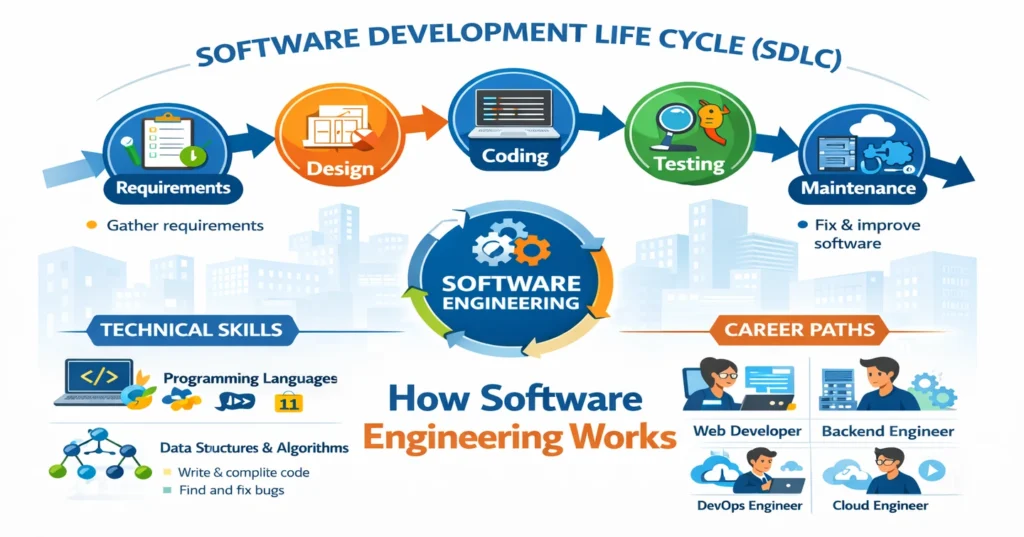
The SDLC is the structured process used to build software in professional environments. Most teams follow these phases (with different styles like Agile, Scrum, or DevOps):
- Requirement Analysis (what problem are we solving?)
- Planning (timeline, scope, constraints)
- Design & Architecture (how the system will work)
- Development (coding the solution)
- Testing & QA (ensuring quality and reliability)
- Deployment (releasing to real users)
- Maintenance (fixing, improving, scaling)
Beginner tip: If you only learn “coding,” you’ll struggle in real jobs. If you learn SDLC thinking, you become valuable fast.
Core Skills You Need (Technical + Soft Skills)
1) Programming Fundamentals
You don’t need 10 languages. You need strong fundamentals in one language and the ability to learn others. Common choices:
- Python (beginner-friendly)
- JavaScript (web and backend)
- Java / C# (enterprise)
2) Data Structures & Algorithms
This is how you write software that is fast, efficient, and scalable—especially in interviews and real performance work.
3) Databases (SQL + Basics)
Most real software stores data. Learn SQL early and understand how databases work.
4) Version Control (Git)
Git is how teams collaborate safely. If you want to work professionally, Git is not optional.
5) Testing & Debugging Mindset
Software engineers don’t “hope” software works. They verify it—using unit tests, integration tests, and careful debugging habits.
6) Security Awareness
Security is part of engineering now. Even beginners should learn the basics of threats and safe handling of data. This internal LookPK guide is a great foundation: What Is Cybersecurity? Importance & Types.
7) Soft Skills (Your Hidden Career Accelerator)
- Communication: explain problems clearly
- Teamwork: work with designers, PMs, QA, DevOps
- Problem-solving: break big problems into small steps
- Discipline: consistency beats “motivation”
Types of Software Engineers
- Front-End Engineer: UI, user experience, browser-based apps
- Back-End Engineer: servers, APIs, databases, authentication
- Full-Stack Engineer: both front-end and back-end
- QA / Test Engineer: automated testing, quality systems
- DevOps Engineer: deployment, CI/CD, cloud infrastructure
- Mobile Engineer: Android/iOS apps
- Cloud Engineer: cloud architecture and services
If cloud concepts are new to you, start here: What Is Cloud Computing? A Complete Beginner’s Guide.
9 High-Paying Careers in Software Engineering
These career paths are common globally. Your choice depends on your interests, strengths, and the type of work you enjoy.
1) Software Developer / Software Engineer
Builds applications and systems. Strong generalist path.
2) Web Developer (Front-End / Back-End / Full-Stack)
Builds websites and web apps. Great for beginners because progress is visible.
3) Mobile App Developer
Creates Android/iOS apps. Strong demand in product companies.
4) QA Automation Engineer
Builds automated testing systems to protect software quality.
5) DevOps Engineer
Automates deployments and improves stability, monitoring, and scaling.
6) Cloud Engineer
Designs and manages cloud-based systems and services.
7) Data / Backend Engineer
Works heavily with APIs, databases, and performance.
8) Security Engineer (Application Security)
Helps protect software from vulnerabilities and attacks.
9) AI/ML Engineer (Software + Models)
Combines software engineering with machine learning. If you’re exploring this route, these LookPK guides can help:
- What Is Artificial Intelligence (AI)?
- Machine Learning for Beginners
- What Is Data Science? Roadmap for Students
Job Outlook & Why Demand Keeps Growing
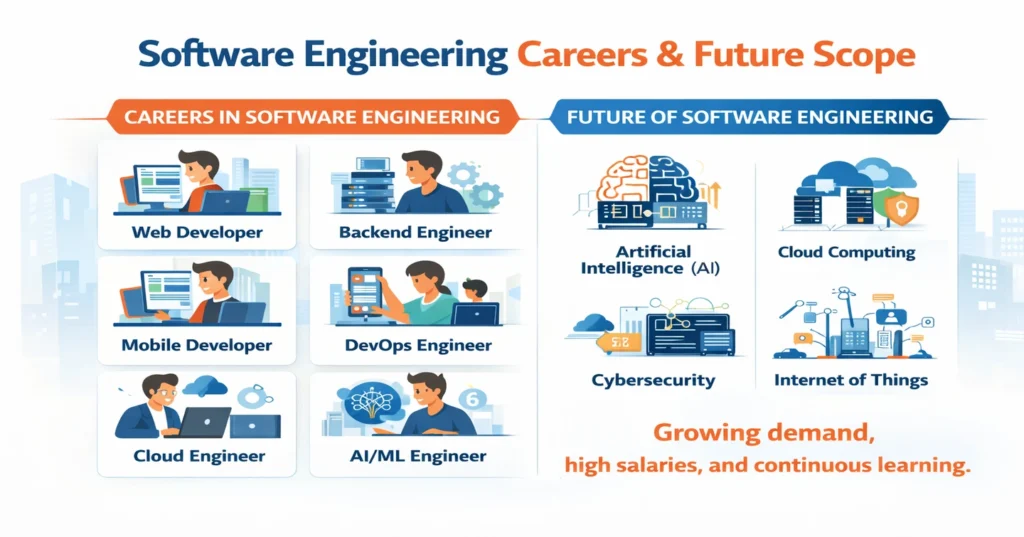
Software roles continue to grow because every industry is becoming tech-enabled. The U.S. Bureau of Labor Statistics projects strong growth for software developers, QA analysts, and testers over the coming decade (2024–2034), reflecting sustained demand: BLS – Software Developers, QA Analysts, and Testers.
How Beginners Should Start (Simple Roadmap)
- Pick one path: Web, Mobile, Backend, or QA
- Learn one language well (Python or JavaScript are solid starts)
- Build 3–5 small projects (portfolio proof beats certificates)
- Learn Git and push projects to GitHub
- Learn basics of testing and clean code
- Study SDLC and teamwork workflows
FAQs (Beginner Questions)
Is software engineering hard for beginners?
It can feel difficult at first, but it becomes manageable when you learn step-by-step and build small projects consistently.
Do I need a computer science degree to become a software engineer?
No. A degree helps, but many people enter through self-learning and projects. Employers mainly care about skills, problem-solving, and proof of work.
What is the best first language for software engineering?
Python is excellent for beginners. JavaScript is best if you want web development quickly. Choose one and go deep.
How long does it take to become job-ready?
If you learn consistently (60–90 minutes/day) and build projects, many beginners become job-ready in 9–12 months.
Which software engineering career pays the most?
Pay depends on location and skill, but roles like backend engineering, cloud engineering, DevOps, and security commonly pay well—especially with strong projects and real experience.
Conclusion
Software engineering is not just “writing code.” It is a professional discipline that combines design, development, testing, deployment, and long-term maintenance. For students and beginners, it offers one of the strongest career paths available today—if you learn fundamentals, build projects, and think like an engineer.